
Three Approaches To Competency Model Building
[fusion_builder_container hundred_percent=”no” equal_height_columns=”no” hide_on_mobile=”small-visibility,medium-visibility,large-visibility” background_position=”center center” background_repeat=”no-repeat” fade=”no” background_parallax=”none” parallax_speed=”0.3″ video_aspect_ratio=”16:9″ video_loop=”yes” video_mute=”yes” border_style=”solid” flex_column_spacing=”0px” type=”legacy”][fusion_builder_row][fusion_builder_column type=”1_1″ type=”1_1″ background_position=”left top” background_color=”” border_color=”” border_style=”solid” border_position=”all” spacing=”yes” background_image=”” background_repeat=”no-repeat” padding_top=”” padding_right=”” padding_bottom=”” padding_left=”” margin_top=”0px” margin_bottom=”0px” class=”” id=”” animation_type=”” animation_speed=”0.3″ animation_direction=”left” hide_on_mobile=”small-visibility,medium-visibility,large-visibility” center_content=”no” last=”true” min_height=”” hover_type=”none” link=”” first=”true”][fusion_text]
When deciding how to approach a competency model building project, it is useful to consider three distinctive approaches:
- Single Job Competency Model
- One-Size-Fits-All Approach
- Multiple Job Approach
A project usually focuses on one of these approaches, although it is possible to use a combination of these approaches within one organization.
Single Job Competency Model
This approach focuses on a single, narrowly defined job that is important to the organization’s success and has at least 10 job holders. The jobs covered by the competency model should have similar responsibilities and performance measures. Any requirements for technical skill or knowledge should be similar across the set of jobs. Examples of jobs for which a single job competency model is appropriate include sales representative, customer service representative, project manager, and plant manager.
The single job approach uses extensive and rigorous data collection, to ensure that the competency model contains highly specific behavioral descriptions of what one needs to do and how, in order to achieve superior results. This approach often includes a detailed breakdown of the main responsibilities and tasks and shows how they are linked to the competencies. Compared to the other two approaches, the single job approach is more time consuming and expensive to implement.
Data Gathering for the Single Job Approach
Usually, in the single job approach, data are gathered in multiple ways. For example, job analysis interviews may be used with job holders to identify main responsibilities, break each main responsibility down into tasks and sub-tasks. A resource panel, comprised of several job holders and several managers of jobholders, may be used to gather the same type of information, as well as information about performance criteria and measures and about changes in the business and organizational context that have implications for new and emerging competency requirements. In order to develop highly detailed behavioral descriptions of the competencies, the Single Job Approach almost always includes structured behavioral interviews with superior performers in the job, in which these persons are asked to provide detailed accounts of how they approached several key tasks or work situations.
Advantages of the Single Job Approach
A competency model built using the Single Job Approach has high face validity and high credibility with job holders and their managers. The model provides a recipe for superior performance. The specific behavioral descriptions of the competencies are useful when developing training programs. The rigor of the methodology ensures that if the organization wishes to use the model for selection, there will be a strong legal justification for doing so.
Disadvantages of the Single Job Approach
Because this approach targets a single, narrowly defined job, the competency model and HR applications built on it affect a relatively small number of employees. As noted earlier, the Single Job Approach is relatively expensive and time consuming to implement, especially if competency models are desired for multiple jobs.
When the Single Job Approach is Appropriate
This approach is most appropriate when:
- There is an opportunity to gain competitive advantage by improving the productivity of people in a key job
- The potential productivity gains from applying the model justify the time and expense of building it
- There is a need to use the competency model as a basis for developing a training program or curriculum
- The organization currently has several superior performers in the job
- The job is expected to continue to exist in the organization for at least three years.
More about the…..
The One-Size-Fits-All Approach
Multiple Jobs Approach
Advantages of One-Size-Fits-All and Multiple Jobs Approaches
Reprint: Building Competency Models – Approaches for HR Professionals
As taught in Workitect’s Building Competency Models workshop.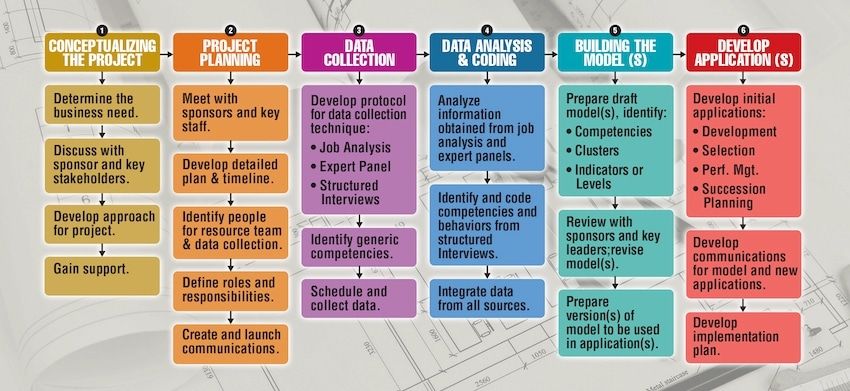
 To learn more about our products and services, and how competencies and competency models can help your organization, call 800-870-9490, email edward.cripe@workitect.com
or use the contact form at Workitect.
©️2021, Workitect, Inc.
[/fusion_text][/fusion_builder_column][/fusion_builder_row][/fusion_builder_container]
Related Posts
Recent Posts

In Good Times & Tough Times, You Need Competent People
People. Not money, not buildings, not tools. Competent people are your most valuable resource. And…

What is the One-Size-Fits-All Competency Model?
In the One-Size-Fits-All Approach, a competency model is developed for a broadly defined set of…

Is Your Performance Management System Working?
If it isn’t working, consider a… COMPETENCY-BASED PERFORMANCE MANAGEMENT SYSTEM Many organizations are becoming…

The New Reality: Career Streams vs. Career Ladders
Along with many other changes in how employee performance is managed, there is a…