Competency Modeling: Think through the Business Needs
Competency modeling is a mainstream HR management practice that has evolved considerable over the past 30 years, mainly in response to changes in organizations and the workplace.
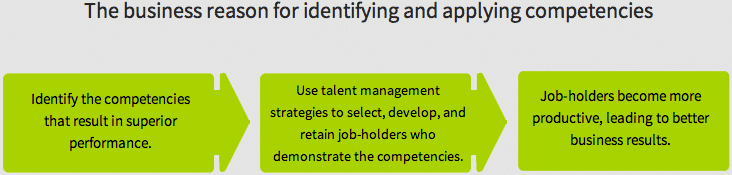
Although not the objective of this article, it is interesting to understand why competency modeling took hold and became widespread. Of course, personal characteristics are, to many, more interesting than tasks, and insights about outstanding performance are more interesting than those about effective performance. But beyond personal preferences, the success of competency models is that they work well as unifying frameworks for a variety of applications in HR management. A manageable set of personal characteristics can serve as a conceptual framework for selection, assessment, professional development, performance management and other human resources programs.
What’s more, competency models describe emerging and anticipated skill requirements, rather than skills that have been effective in the past, which serves the needs of new or restructuring organizations.
Approach and applications: What’s your style?
If you’re contemplating building a competency model for your organization, you first need to identify the applications of the model (selection, assessment, professional development, performance management, etc.), as well as your business needs and culture in order to determine whether you need to implement a single-job model, a one-size-fits-all approach or a multiple-job model.
a. Single-Job approach
The single-job approach focuses on a single, narrowly defined job that is important to the organization’s success and for which there are at least 10 employees. This model may apply to more than one role, but the jobs covered by the model should have similar responsibilities and performance measures. For instance, this approach would be appropriate for sales representatives, customer service representatives and project managers.
Compared to the other two approaches, the single job approach is more time consuming and expensive to implement. Yet, it also has high face validity and high credibility with jobholders and their managers. The model provides a recipe for superior performance, and the specific behavioral descriptions are useful when developing training programs.
b. One-Size-Fits-All approach
The One-Size-Fits-All approach is typically applied to a broadly defined set of jobs that may have very different responsibilities and knowledge requirements, but share the same level, such as managers, associates or senior leaders. It serves to send a clear and simple message about the personal characteristics and skills that the organization considers to be important.
The competencies of this model are often described in general terms that are not job specific. As a result, employees may not feel that it applies well to their particular role. Yet, this approach is particularly appropriate when management wants to promote alignment with vision, values and strategy, with little complexity or when the budget for developing competency models is limited.
c. Multiple Jobs approach
In the Multiple Jobs approach, competency models are developed simultaneously for a set of jobs (e.g., all professional jobs in marketing; all R&D jobs, or all the job in a small organization).
To ensure consistency among the models, it is crucial to first identify a set of building block competencies from which each competency model will be constructed. One source of building block competencies is a generic competency dictionary, which is then adapted to fit the organization’s language and culture. These dictionaries typically focus on non-technical competencies so if the competency models need to include technical skills and knowledge, as is often the case, a set of relevant technical skill/knowledge competencies can be identified with the help of subject matter experts.
This approach is appropriate when HR staff plan to apply the competency models for career planning and succession planning, which involve matching employee assessments to the requirements of multiple jobs. One advantage is that the models cover many jobs in an organization, thus achieving a broad impact. Plus, the building block competencies can become a common conceptual framework for the requirements of different jobs and from which HR can develop a training curriculum and other developmental experiences applicable across jobs.
The right tools
Regardless of the approach or application of your model(s), you need to acquire the right tools to get you started. As previously mentioned, generic competency dictionaries are indeed a crucial tool for creating a framework of competencies within a job role or level. Furthermore, they allow the organization to build and implement integrated talent management systems.
Beyond the dictionaries, you may also want to look into acquiring competency development manuals, eDeveloper™, 360° survey instruments and interview guides. Many of these tools can be purchased or licensed, and can prove to be indispensable to your modeling process.
To learn more about competency modeling steps, customizing a dictionary to your needs, or the tools that can further assist you in the process, click here: https://workitect.com/Products-and-Licenses/index.html
 To learn more about our products and services, and how competencies and competency models can help your organization, call 800-870-9490, email edward.cripe@workitect.com
or use the contact form at Workitect.
©️2019, Workitect, Inc.

Tags: business strategy, competencies, competency dictionary, competency framework, competency models, HR, HR strategy, interviewing, job competencies, talent management, talent strategies
Related Posts
Recent Posts

In Good Times & Tough Times, You Need Competent People
People. Not money, not buildings, not tools. Competent people are your most valuable resource. And…

What is the One-Size-Fits-All Competency Model?
In the One-Size-Fits-All Approach, a competency model is developed for a broadly defined set of…
Is Your Performance Management System Working?
If it isn’t working, consider a… COMPETENCY-BASED PERFORMANCE MANAGEMENT SYSTEM Many organizations are becoming…

The New Reality: Career Streams vs. Career Ladders
Along with many other changes in how employee performance is managed, there is a…