
The Business Case for Competencies – Part Two
Read More in Part One
Background
In 1996, the American Compensation Association (now WorldAtWork) sponsored a research study titled “Raising the Bar – Using Competencies to Enhance Employee Performance”. The results were published in a 76-page booklet, which has been long out of print. I recently discovered and re-read a copy I had filed away. What is interesting is that most of the findings are still relevant and insightful today. This section is taken from Part 4, “The Business Case for Competencies”, pages 15-18.
_____________________________________________________________________________
To get a sense of how business and human resources strategy might impact decisions about competency applications, the research team had asked participating companies to state their primary business strategy objectives, how their HR strategies support these objectives and the intended purpose of implementing competency-based applications.
A Review of the Data
Following is a summary of specific findings identified by data collected from 217 organizations that filled out the primary questionnaire for this study:
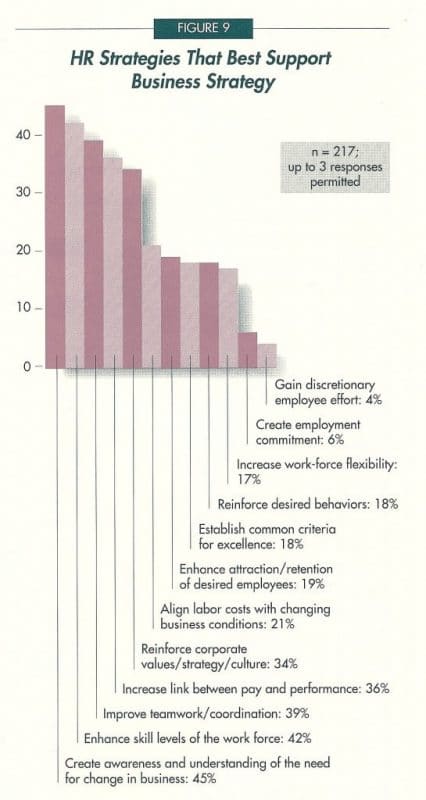
- A variety of HR strategies are identified that best support business strategies. Respondents identified from the list that appears in Figure 9 (above) the three most important human resources strategies that best support their broader business strategy. It is common for respondents to use these strategies in combination. Again, while many of these strategies are generic, they show the human resources context in which competency models are being created.The most frequently cited human resources strategies are:
- creating awareness and understanding of the need for change in business
- enhancing work-force skill levels
- improving teamwork/coordination, increasing the link between pay and performance
- reinforcing corporate values/strategy/culture.
For manufacturing respondents, the top strategies are creating awareness of the need for change and improving teamwork/coordination. Among service respondents, the top strategies are reinforcing corporate values/strategy/culture, enhancing work-force skill levels, and increasing the link between pay and performance.
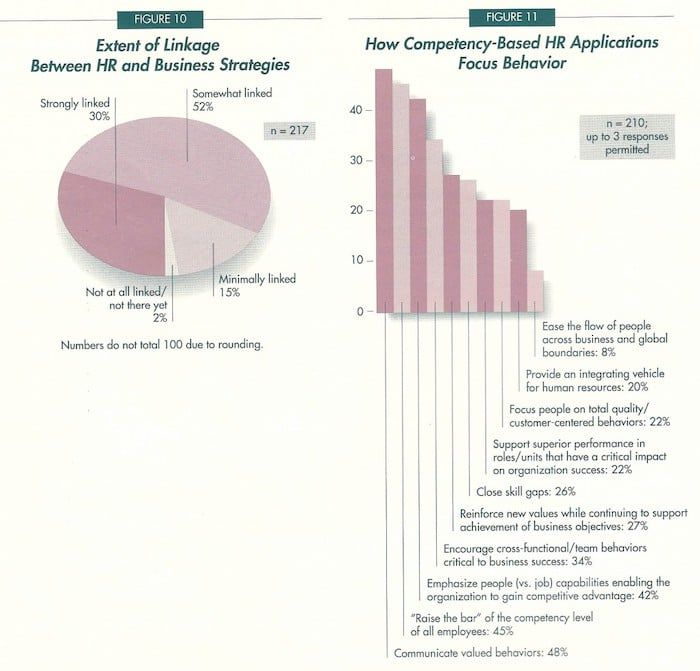
• HR and business strategies are not strongly linked. Respondents indicated how well their human resources strategies support their broader business strategists. Given that HR and business strategies should be linked, it is interesting to note that less than one-third of respondents see their human resources strategy as strongly linked to business strategy. (See Figure 10 below)
• Competency-based applications focus behavior. Respondents indicated how competency-based HR applications are intended to best support their organizations business objectives. The three most frequently cited expectations are that competencies will enable the company to communicate desired behaviors, raise the competency level of all employees and emphasize people capabilities that lead to competitive advantage. These also constitute the most popular combination of responses, with 6% of all respondents choosing all three. (Figure 11)
When asked to comment on the effectiveness of competency-based programs in achieving their expectations, a substantial majority of respondents said it was too early to render an opinion. In fact, few respondents have quantitative measures of effectiveness. However, early indicators suggest that competency-based applications are helping organizations achieve their primary business objectives. This is particularly true for respondents with applications in place for one year or more. Within this group, competencies are clearly viewed as having a positive effect on achieving the three most desired results mentioned above.
What do you think? What has been the effectiveness of competency-based applications in your organization?
 To learn more about our products and services, and how competencies and competency models can help your organization, call 800-870-9490, email edward.cripe@workitect.com
or use the contact form at Workitect.
©️2024, Workitect, Inc.

Tags: business strategy, change management, competency, competency modeling, HR, HR strategy, strategy
Related Posts
Recent Posts

In Good Times & Tough Times, You Need Competent People
People. Not money, not buildings, not tools. Competent people are your most valuable resource. And…

What is the One-Size-Fits-All Competency Model?
In the One-Size-Fits-All Approach, a competency model is developed for a broadly defined set of…
Is Your Performance Management System Working?
If it isn’t working, consider a… COMPETENCY-BASED PERFORMANCE MANAGEMENT SYSTEM Many organizations are becoming…

The New Reality: Career Streams vs. Career Ladders
Along with many other changes in how employee performance is managed, there is a…