

Leadership Through Empowering Others

Research has regularly demonstrated that when employees feel empowered at work, it is associated with stronger job performance, job satisfaction, and commitment to the organization.
Many leaders today often try to empower their employees by delegating authority and decision-making, sharing information, and asking for their input. But recent research reported in the Harvard Business Review found that this style of leadership works best in motivating certain types of performance and certain types of employees. Empowering others should know when they can be most effective.
Empowering Others is a key leadership competency that is defined in Workitect’s Competency Dictionary as: Conveying confidence in employees’ ability to be successful, especially at challenging new tasks; delegating significant responsibility and authority; allowing employees freedom to decide how they will accomplish their goals and resolve issues.
These are the behavioral indicators that describe specific ways in which the Empowering Others competency is demonstrated:
- Gives people latitude to make decisions in their own sphere of work
- Is able to let others make decisions and take charge
- Encourages individuals and groups to set their own goals, consistent with business goals
- Expresses confidence in the ability of others to be successful
- Encourages groups to resolve problems on their own; avoids prescribing a solution
Developing “Empowering Others”
IMPORTANCE OF THIS COMPETENCY
Empowering Others, the successful sharing of decision making and problem solving responsibilities is important to organizations for at least four reasons. First, it enables faster decisions and more responsiveness to internal and external customers and thus enhances an organization’s productivity and competitiveness. Second, empowerment leads to better utilization of people’s skills. Empowered employees, who do a wider variety of tasks, develop the skills to do these tasks; and managers, who spend much less time monitoring and controlling, can focus on activities that are often neglected, such as strategic planning and staff development. Third, employees who are empowered develop more self-confidence and higher morale. Finally, many of the new organizational forms that are being developed to increase competitiveness, such as self-managed teams, and flatter, less hierarchical organizations, require empowerment to be successful.
GENERAL CONSIDERATIONS IN DEVELOPING THIS COMPETENCY
Developing this competency does not require much in the way of new skills; it is more a matter of rethinking your approach to management. If your management style has emphasized control — giving orders, making decisions, and monitoring performance, empowerment will require significant change on your part. Unless you build the groundwork for this change, it is likely to be unsuccessful. The danger is that you will share authority, your employees will make poor decisions, you will take back authority, and everyone will be unhappy about what happened.
To successfully empower others, you must build the groundwork for change and implement it gradually by:
- Discussing and clarifying expectations about your new role as a coach and resource provider and the employees’ new roles as responsible and accountable problem solvers and decision makers
- Ensuring that employees get any training they will need
- Ensuring that employees have access to the information they will need
- Providing guidelines, parameters regarding limits of empowerment
- Using leading questions to coach and model the processes of problem solving and decision making
- Recognizing and praising behaviors reflecting responsible decision making and problem solving
- Creating a climate where experimentation is encouraged and mistakes are treated as opportunities for learning
You can learn more about implementing this competency by talking to someone who has done it successfully and by reading books on this topic.
PRACTICING THIS COMPETENCY
Talk to an employee or to a group of employees and explain what you would like to do in terms of empowering them. Clarify what your own role will be and what role you would like the employee(s) to have.
Coach a group through a decision making process by asking questions that lead the group through the thinking process required to make a good decision. Use questions like these:
- What are the criteria for a good decision in this case?
- What information do I have that will be needed?
- What additional information do I need, and how can I get it?
- What are the alternatives?
- How should I go about choosing among the alternatives?
- What are the risks associated with each alternative?
Empower an individual or group to make a decision or solve a problem. Be sure you have provided the resources and information needed to do this effectively.
Over a two-week period make a point of noticing and praising behaviors that indicate that your employees are successfully demonstrating empowerment.
OBTAINING FEEDBACK
After a period in which you have empowered employees to make a certain kind of decision or solve a certain type of problem, lead a debriefing and learning session on a particular decision or problem. Find out what the employee(s) did and how, and ask the group to identify learning points — things that you or they could do differently in the future. Keep the focus on learning, not on blaming.
Periodically ask employees about their perception of how the empowerment process is going. Ask what you can do differently, to make the process more effective.
LEARNING FROM EXPERTS
Interview someone in your own or another organization who has successfully empowered employees. Ask how the person went about the process, what worked and what didn’t, what problems were encountered, and how the person addressed them.
COACHING SUGGESTIONS FOR MANAGERS
If you are coaching someone who is trying to develop this competency, you can:
- Model the process of empowerment with this person
- Help the person develop a plan for empowerment
- Discuss how the process is going and offer feedback and suggestions
- Assign this person to a team or task force headed by someone strong in empowerment
SAMPLE DEVELOPMENT GOALS
By December 2, I will meet with my employees, explain empowerment, and clarify expectations about their role and mine.
By December 10, I will interview Sandy Dunbar to learn how she has empowered the staff in her unit.
By December 20, I will hold a session with my team, to coach them through the process of planning a bid.
By January 10, I will read Empowerment in Organizations, by Vogt and Murrell and make a list of ideas that I can apply with my Production team.
BOOKS, SELF-STUDY COURSES, EXTERNAL COURSES, EXTERNAL RESOURCES
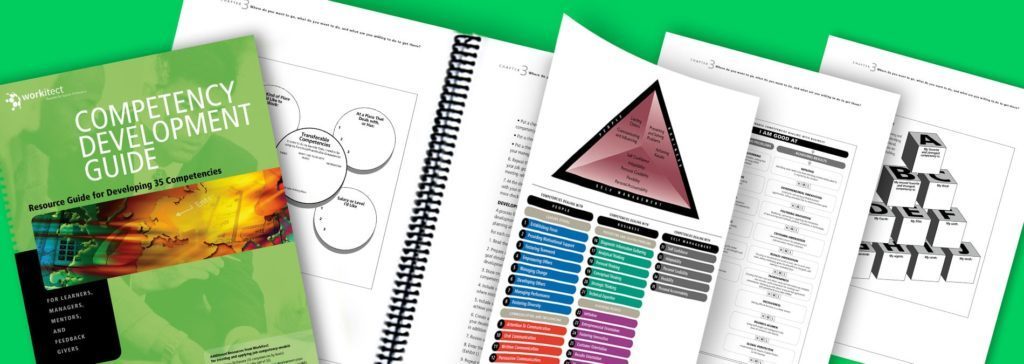
Are listed in Workitect’s Competency Development Guide, along with variety of planning forms and career planning instructional material.
 To learn more about our products and services, and how competencies and competency models can help your organization, call 800-870-9490, email edward.cripe@workitect.com
or use the contact form at Workitect.
©️2019, Workitect, Inc.

Related Posts
Recent Posts

In Good Times & Tough Times, You Need Competent People
People. Not money, not buildings, not tools. Competent people are your most valuable resource. And…

What is the One-Size-Fits-All Competency Model?
In the One-Size-Fits-All Approach, a competency model is developed for a broadly defined set of…

Is Your Performance Management System Working?
If it isn’t working, consider a… COMPETENCY-BASED PERFORMANCE MANAGEMENT SYSTEM Many organizations are becoming…

The New Reality: Career Streams vs. Career Ladders
Along with many other changes in how employee performance is managed, there is a…