

What will key users of a competency model need from it?
The planning of a competency model requires identifying the most important stakeholders and users and considering how they will want to use the model.
People in the job often want to use a competency model to provide a recipe for success. These users are asking, “What could I be doing differently that would make me more effective?” They are likely to value very specifically worded behavioral indicators that describe what to do, with whom, and in what circumstances. A matrix linking the competencies to major job tasks is also helpful to job incumbents.
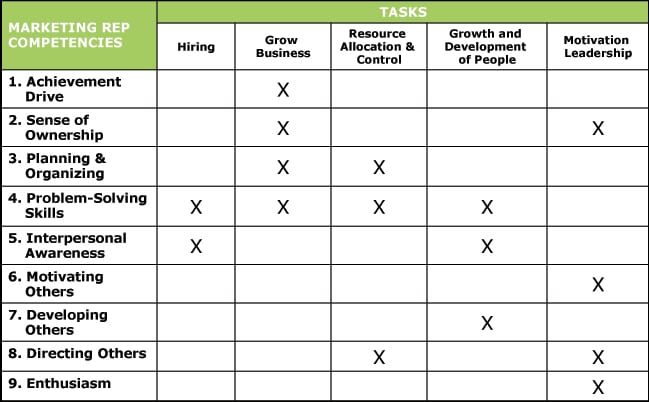
Supervisors can use the same detailed information to assist in coaching jobholders. Since part of a supervisor’s job is also providing detailed feedback about effective and less effective behaviors, descriptions of less effective behaviors associated with each competency are beneficial. For the same reason, supervisors may find it useful to have a matrix linking the competencies to key performance criteria and measures. Because supervisors are also in charge of hiring for the position, they need a competency model that includes all of the important skills and qualifications required for the position, including technical skills and educational credentials that are baseline requirements for all jobholders. Here is an example of such a model, one developed for a Marketing Representative position in an insurance company.
Human Resources professionals who will be using a competency model have a different set of needs. HR staff may need to build a shared conceptual framework of competencies and a common language for describing the competencies. They can then facilitate matching skill profiles to different jobs through selection, promotion, and career-path planning; and the creation of training and development programs for people across a broad range of jobs. HR staff also need easy ways to compare the requirements of different jobs in the organization. It is useful for the human resources staff to be able to say which competencies are required for a job and the level at which the competencies need to be demonstrated, to achieve effective performance. Since Human Resources staff often need to communicate and explain a competency model, competency models that are clear, simple, and written with powerful language are preferred.
Key Question to Answer before Building Competency Models
When planning the development of a competency model or models, there are practical considerations that affect the design of the project, the format and content of the competency model, and the success of the project’s implementation. The following seven questions may be useful to Human Resouces professionals responsible for planning and implementation:
- What HR application should be included in the initial model building project?
- What will the key users of the model need from it? (covered in this blog)
- How should key stakeholders be involved?
- How extensive should the data collection be?
- How should research be balanced with intuitive approaches?
- What format of behavioral descriptors will best suit the application?
- How can additional, future competency models be accommodated?
Included in Workitect’s Building Competency Models Workshop and applied in our consulting practice to help organizations develop job competency models and HR and talent management applications, including performance management, succession planning, assessment and selection, and training and development.
Join LinkedIn’s Competency-Based Talent Management Group.
 To learn more about our products and services, and how competencies and competency models can help your organization, call 800-870-9490, email edward.cripe@workitect.com
or use the contact form at Workitect.
©️2019, Workitect, Inc.

Tags: competencies, competency, competency modeling, competency models, HR, HR strategy, human resources
Related Posts
Recent Posts

In Good Times & Tough Times, You Need Competent People
People. Not money, not buildings, not tools. Competent people are your most valuable resource. And…

What is the One-Size-Fits-All Competency Model?
In the One-Size-Fits-All Approach, a competency model is developed for a broadly defined set of…
Is Your Performance Management System Working?
If it isn’t working, consider a… COMPETENCY-BASED PERFORMANCE MANAGEMENT SYSTEM Many organizations are becoming…

The New Reality: Career Streams vs. Career Ladders
Along with many other changes in how employee performance is managed, there is a…