

Include Competencies in Performance Reviews
Competency-Based Performance Management
Many organizations are increasingly interested in the management and appraisal of competence—the “how” of performance. Rather than relying solely on past results, organizations are seeking more qualitative, future-oriented assessments that emphasize employee development. A competency-based approach introduces a broader and more strategic perspective to performance management.
In this approach, performance is viewed not only in terms of what employees achieve, but also how they achieve it. Competency-based performance management integrates planning, ongoing management, and appraisal of both performance outcomes and competency behaviors. It evaluates results alongside the personal characteristics, skills, and behaviors that predict superior performance in current roles and future positions.
Balancing Performance and Competence
A competency-based performance management system balances measurable results with demonstrated competencies. The relative weight assigned to each depends on the nature of the job. For example, in operational or line roles, performance results may account for 90 percent of the appraisal, with competency behaviors weighted at 10 percent. In contrast, service-oriented positions may place 100 percent emphasis on competencies. Staff or professional roles often assign equal weight to results and competency behaviors.
Traditional performance management systems focus on quantifiable, short-term, and past-oriented results, typically tied to organizational or unit goals and compensation decisions. Competency appraisal, however, is more qualitative and forward-looking. It emphasizes long-term capability building, employee development, and career planning rather than immediate rewards.
Performance Focus (“Pay for Results”) 50%-90%
• Emphasizes what is achieved
• Quantitative and goal-based
• Short-term and past-oriented
• Reward-driven
Competency Focus (“Pay for Skills”) 10%-50%
• Emphasizes how results are achieved
• Qualitative and behavior-based
• Long-term and future-oriented
• Development-driven
Many organizations are becoming more interested in management and appraisal of competence – the “how” of performance. They are seeking more qualitative assessment, oriented to the future and focused on development. A competency approach brings a different perspective to performance management. Performance is viewed in terms of the process employees use to achieve their job results. It combines planning, management, and appraisal of both performance results and competency behaviors. It assesses what employees accomplished and how they did it (with personal characteristics they possess that predict superior performance in present jobs, or in future jobs). COMPETENCY-BASED PERFORMANCE MANAGEMENT WEB PAGE
Steps in Developing a Competency-Based System
- Identify Competencies
Identify the competencies required for superior performance in current and future roles. These competencies should align with the organization’s strategic objectives and support desired organizational change. - Train Managers and Employees
Both managers and employees must be trained in performance management and coaching for improvement. Effective competency development relies on structured performance coaching, which includes:
- Assessing Actual Competency Levels
Managers and employees should agree on the employee’s current competency levels. This assessment is often most effective when using 360-degree feedback, which gathers input from supervisors, peers, subordinates, and customers. These results are compared with the employee’s self-assessment to identify gaps and strengths. - Defining Desired Competency Levels
Employees identify the competencies they wish to develop to support their performance goals and career aspirations. - Creating a Development Agreement
Managers and employees jointly establish a development contract that outlines:
• Competency development goals and action steps
• Support, resources, and coaching to be provided by the manager
This coaching approach is grounded in self-directed change theory, which suggests that adults are most likely to change when they:
• Recognize personal benefits from change
• Feel dissatisfaction with their current performance level
• Clearly understand their desired future state
• Know the actions required to bridge the gap between current and desired performance
Implications for Management
Competency-based performance management shifts the focus of appraisal from solely organizational results to employee behaviors and capabilities. When performance falls short, the emphasis moves to identifying which tasks, behaviors, or competencies need improvement. Employees are encouraged to model the behaviors and competencies demonstrated by top performers.
Implementing this system requires a strong managerial commitment to employee development. Managers must provide coaching, training, and ongoing support throughout the performance period. Research consistently shows that training managers in coaching and development is critical to the success of competency-based performance management systems. Employee training is equally important to ensure understanding, engagement, and effective participation in the process.
Conclusion
A competency-based performance management system supports both organizational success and employee growth by aligning performance outcomes with the behaviors and capabilities needed for long-term effectiveness. By integrating results and competencies, organizations can foster continuous improvement, adaptability, and sustained high performance. https://workitect.com/PDF/performance-management.pdf
READ MORE: 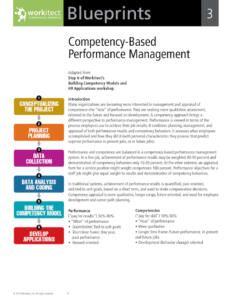
How Competencies Drive Performance Improvement
Make Performance Management a Positive Experience
Optimize Your Performance Management System
Competency-Based Performance Management to Reward Top Performers
RESOURCES
Writing Goals A programmed instruction booklet that teaches employees at all levels how to write effective job goals. 43 short pages (PDF)
Developing the “Managing Performance” Competency From Workitect’s Competency Development Guide, the premier resource guide for developing thirty-five leadership and professional competencies. 6 pages (PDF)
Performance Planning & Review A handbook for employees that explains their role in the planning and review process. It includes sections on setting job goals, reviewing progress, career development, the annual review, and the correlation to compensation actions. 17 pages (PDF)
Developing the “Managing Performance” Competency From Workitect’s Competency Development Guide, the premier resource guide for developing thirty-five leadership and professional competencies. 6 pages (PDF)
Performance Planning & Review A handbook for employees that explains their role in the planning and review process. It includes sections on setting job goals, reviewing progress, career development, the annual review, and the correlation to compensation actions. 17 pages (PDF)
 To learn more about our products and services, and how competencies and competency models can help your organization, call 800-870-9490,
or use the contact form at Workitect.
©️2026, Workitect, Inc.

Tags: competencies, Development, employee performance, leadership assessment development, performance, performance appraisals, performance management, performance reviews, talent management, workforce planning
Related Posts
Recent Posts

In Good Times & Tough Times, You Need Competent People
People. Not money, not buildings, not tools. Competent people are your most valuable resource. And…

What is the One-Size-Fits-All Competency Model?
In the One-Size-Fits-All Approach, a competency model is developed for a broadly defined set of…
Is Your Performance Management System Working?
If it isn’t working, consider a… COMPETENCY-BASED PERFORMANCE MANAGEMENT SYSTEM Many organizations are becoming…

The New Reality: Career Streams vs. Career Ladders
Along with many other changes in how employee performance is managed, there is a…