
HOW TO DEVELOP JOB COMPETENCY MODELS
[fusion_builder_container type=”flex” hundred_percent=”no” equal_height_columns=”no” hide_on_mobile=”small-visibility,medium-visibility,large-visibility” background_position=”center center” background_repeat=”no-repeat” fade=”no” background_parallax=”none” parallax_speed=”0.3″ video_aspect_ratio=”16:9″ video_loop=”yes” video_mute=”yes” border_style=”solid”][fusion_builder_row][fusion_builder_column type=”1_1″ layout=”1_1″ background_position=”left top” border_style=”solid” border_position=”all” spacing=”yes” background_repeat=”no-repeat” margin_top=”0px” margin_bottom=”0px” animation_speed=”0.3″ animation_direction=”left” hide_on_mobile=”small-visibility,medium-visibility,large-visibility” center_content=”no” last=”true” hover_type=”none” background_blend_mode=”overlay” first=”true” min_height=”” link=””][fusion_text]
Part 2 of Integrating Key HR & Talent Management Processes
Examples of Competency Models, including model for Project Managers
Register for live online Building Competency Models Workshop.
Start by focusing on one critical job family – to be identified by the company – and utilizing this as a pilot program. Also demonstrate how to replicate this for other job families and develop a long-range implementation plan.
A Workitect Job Competence Assessment consists of the following steps:
- Define Performance Effectiveness Criteria.
To identify superior job incumbents, it is first necessary to define measures of performance effectiveness in a given job. Ideal criteria are “hard” outcome measures such as sales or productivity data. In the absence of such criteria, supervisor, peer (where peers have an opportunity to observe one another’s performance), subordinate and/or customer ratings can be used. - Identify a Criterion Sample.
Job incumbents who are consistently rated superior on a number of different performance criteria provide a “template” standard for comparison analysis with a sample of average performers in the following steps of the research process.
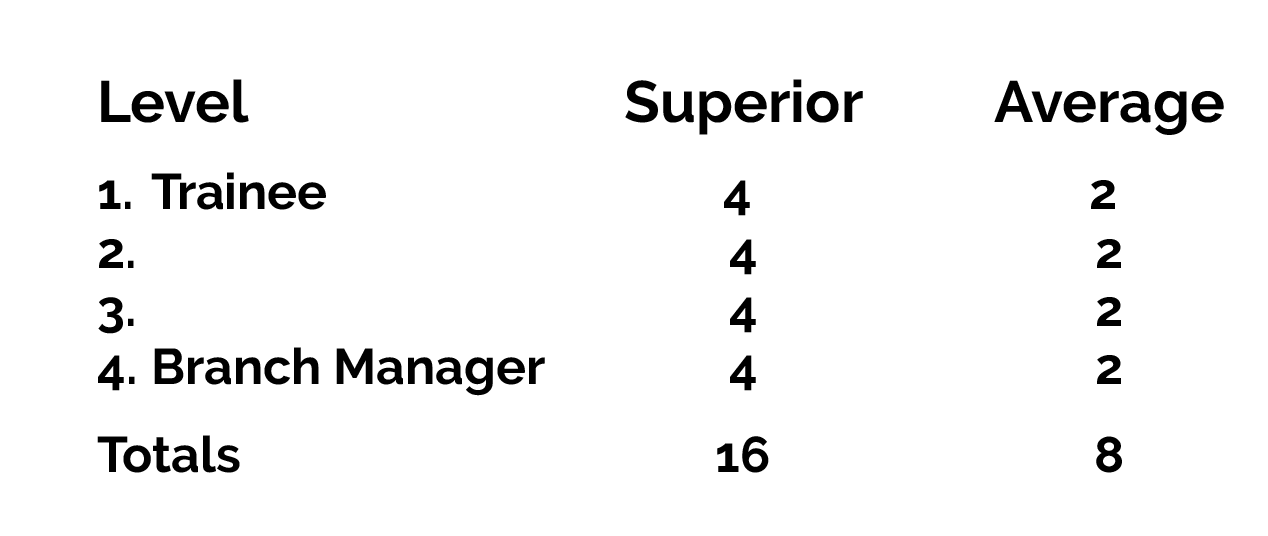
Criterion samples for job families should include superior and average performers at key ascension levels, e.g., from Trainee to Branch Manager:
- Expert Panels.

Managers and knowledgeable employees are asked to identify for key jobs the career paths which typically lead to the job, and thecompetency requirements (behaviors and characteristics) employees need to perform at an adequate or “threshold” level, and at a superior level in the job. Use of expert panels to define job elements offers a number of benefits. Panels collect much valuable data quickly and efficiently. Participation in panel sessions educates panel members in HR assessment methods and variables, and through involvement develops consensus and support for overall project findings and recommendations.
- Job Competency Requirements Survey (JCRS):
A representative sample of managers and employees in the target jobs are asked to complete a survey on competencies required for threshold and superior performance in the job. Surveys permit collection of sufficient data to do statistical analysis and have the added value of broad employee participation, which builds support for survey findings. - Behavioral Event Interviews:
Twenty-four individuals (sixteen superior and eight average incumbents from entry and mid-career jobs in the designated job family) are interviewed using the BEI technique to assess competencies. The BEI asks interviewees to:
A. Identify the most critical situations they have encountered in their jobs and to describe these situations in considerable narrative detail:
– What led up to the situation?
– Who was involved?
– What did the interviewee think about, feel, and want to accomplish in dealing with the situation?
– What did he or she actually do?
– What was the outcome of the incident?
B. Identify the key developmental steps and experiences in their careers which led to their current job.
 BEI protocols also provide a wealth of data for the identification of competencies and very specific descriptions of critical job behaviors in specific situations. Interviewees’ career paths can be mapped and it can be determined when, where, and how they acquired key competencies. A significant by-product of these interviews is the generation of numerous situation and problem narratives that can be used to develop highly relevant training materials, e. g., case studies, role plays, and simulations.
Advantages of the BEI method include: Empirical identification of competencies beyond or different from those generated by panels. Precision about what competencies are and how they are expressed in specific jobs and organizations (e.g., not only “use of influence” but examples of how influence is used to deal with specific job situations).
- Thematic Analysis and Development of a “Competency Model” for the Job:
Data from the expert panels, surveys, expert system, and BEIs are content-analyzed to identify behaviors and personality characteristics that distinguish superior from average job incumbents. Two or more analysts (one from Merit, one or more from the client company) examine the data and identify candidate competencies that are present or absent in superior as compared with average performers. These elements are refined until they can be recognized with acceptable inter-rater reliability. A detailed competency dictionary and codebook is prepared to guide empirical coding of interview, assessment center, or other operant data from job incumbents or candidates. This dictionary/codebook provides the competency model for the job.
The output of the Job Analysis step will be comprehensive Job Competency Models, which include:
- Purpose and content of the job: tasks, responsibilities and performance measures for the job rated as to level, frequency, and importance in a form which can be used to compare the job’s content with other jobs.
- Competency requirements: the skills and characteristics required for adequate and superior performance in the job.
- Career paths for the job, with focus on when, where, and how key competencies for the jobs are developed.
Designing a Model-Building Process Tailored to your Needs
Where appropriate, other sources of data can be used to create a competency model. These include:
- Interviews with people in similar jobs in other companies.
- Interviews with subordinates, supervisors or customers of persons in the target job.
- Focus groups of job incumbents.
- Review of competency models of similar jobs in other organizations.
- Literature searches.
A model can often be built quickly and at low cost through interviews with superior performers, a panel session with managers and incumbents, and/or a focus group of job incumbents.
Another consideration is that with re-engineering, new jobs are being created for which there are few, if any, precedents. This is another reason to design a model building process that meets the specific needs of each client.
Part 3 of Integrating Key HR & Talent Management Processes will be about developing applications of the model.
Also available in “Integrating HR and Talent Management Processes” in the Resources and Support section of Workitect.com.
Competency model-building consulting help from Workitect >>>
Relevant Blog Posts
Are Job Competency Models Too Complex?
The Format and Content of Customized Competency Models
The Power of Customization in Competency Modeling
IMPLEMENTATION TOOLS FROM WORKITECT
For additional information, contact us at 800-870-9490, info@workitect.com
Or submit this contact request form.
Workitect is the leading developer of job competency models and
competency-based human resource applications, tools, and programs.
©2024, Workitect, Inc.
[/fusion_text][/fusion_builder_column][/fusion_builder_row][/fusion_builder_container]
Tags: assessment, building, competencies, competency modeling, competency models, competency system, job competencies, McBer, talent management, talent management system
Related Posts
Recent Posts

In Good Times & Tough Times, You Need Competent People
People. Not money, not buildings, not tools. Competent people are your most valuable resource. And…

What is the One-Size-Fits-All Competency Model?
In the One-Size-Fits-All Approach, a competency model is developed for a broadly defined set of…
Is Your Performance Management System Working?
If it isn’t working, consider a… COMPETENCY-BASED PERFORMANCE MANAGEMENT SYSTEM Many organizations are becoming…

The New Reality: Career Streams vs. Career Ladders
Along with many other changes in how employee performance is managed, there is a…