The Cost of Higher Quality Decision-Making
How do successful human resource teams manage to do more with less, thus earning their respective title? Less staff, less outsourcing… all thanks to higher quality decision-making, which drives lower costs. Sounds easy enough, right? It doesn’t have to be complicated.
Here’s a little insight to how having an integrated talent management approach can help manage costs and promote resiliency.
Foster resiliency, foster freedom
We all ideally want to achieve that sense of purpose in our careers – after all, our “job” is simply an aspect of identity, while our “career” serves as an aspect of our lives. When the concept of resiliency is fostered by the HR function, both parties (HR and employees) are provided the freedom to make choices and act on them, thus allowing everyone involved to feel ‘in control’ of their professional life. This, in turn, assists in boosting productivity and overall performance.
Some tips for promoting resiliency include:
- Engaging employees via communication regarding the influence they hold in daily tasks and their career paths.
- Re-framing stress into opportunities for growth & development (i.e., incentives).
- Cultivating creativity by involving employees in the process of any organizational change.
Research has shown that the more an individual views their job as a calling rather than simply a set of tasks, the more committed they are in the workplace. By fostering resiliency and applying tips, such as those mentioned in the above bullet points, you allow your employees to adopt a sense of freedom and true purpose – and a better chance they will stick around in the face of high-stress situations or corporate change.
Sharing a common language
Along with cultivating a resilient staff, successful HR organizations understand how to remain focused on the business’s objectives in order to effectively identify the skills needed for the job, both present day and well into the future.
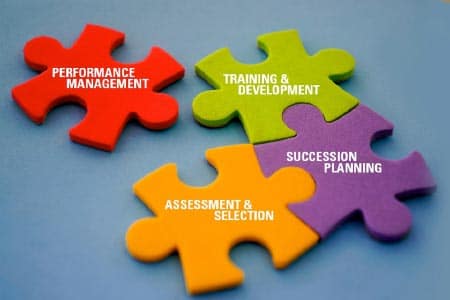
Before adopting a talent management program, it’s important to recognize what it means for the HR function to ‘share a common language’. An integrated talent management system shares a communicative architecture, contrasting from a typical system where:
1) Selection decisions are made via one set of criteria
2) Performance is appraised on a second set of criteria
3) The training function teaches a third set of skills
Using a more integrated approach, for example a selection decision, is based on the understanding of not only on how employees should be identified, but how their skills align with the company’s vision and culture.
To learn how you can begin taking the first steps to successfully do more with less by fostering resiliency and building an effectively integrated talent management system, please visit our webpage.
 To learn more about our products and services, and how competencies and competency models can help your organization, call 800-870-9490, email info@workitect.com
or use the contact form at Workitect.
©️2019, Workitect, Inc.

Tags: business strategy, competencies, employee selection, HR, interviewing, job competencies, McBer, modeling, performance, productivity, succession planning, talent, talent management, workforce planning
Related Posts
Recent Posts

In Good Times & Tough Times, You Need Competent People
People. Not money, not buildings, not tools. Competent people are your most valuable resource. And…

What is the One-Size-Fits-All Competency Model?
In the One-Size-Fits-All Approach, a competency model is developed for a broadly defined set of…
Is Your Performance Management System Working?
If it isn’t working, consider a… COMPETENCY-BASED PERFORMANCE MANAGEMENT SYSTEM Many organizations are becoming…

The New Reality: Career Streams vs. Career Ladders
Along with many other changes in how employee performance is managed, there is a…