

Executive Power: A Form of Bullying or Effective Leadership?
When Marissa Mayer took over the leadership at Yahoo!, headlines of radical changes to strategy, direction and company policies flooded the papers. She came on board taking charge, and making sure everyone knew that it would be her way or the highway.
Many senior executives who assume control of a company feel that it is important to come in with a bang. It asserts leadership, and demonstrates that the status quo will no longer be tolerated. Things are about to change.
Typically, this behavior is exerted with good intentions; often, the new executive has a vision and a strategy, and intends to make it happen as fast as possible to prove his/her worth to the board in this new role. But is it really effective?
The leadership competency: Empowerment as a driver of change
There are several types of leaders and thus, many different characteristics to describe leadership. While subjective in nature, it is up to the organization to determine the type of leader it seeks in a given role, depending on the main task at hand.
Yet, despite the laundry list of competencies to be mastered to become a truly efficient leader for any sort of change to occur successfully within an organization, employees need to be given reasons to “want” to change.
Barking orders and demands at employees may help establish who’s in control, but it isn’t likely to encourage employees to desire change, and much less to support the company’s growth and success.
Rather, in today’s environment, CEOs and senior executives would generate much better results by joining the workforce as a team member, enlisting every person’s opinion and expertise in furthering the company, and empowering them with responsibilities to make it happen.
Can leadership be taught, or is it all a matter of personality type?
There is a great debate raging on about whether or not leadership – good leadership – can be taught. While some individuals are indeed natural born leaders, knowing exactly how to exert positive influence and assemble the troops, does this mean that leadership skills are purely genetic?
In October 2013, William F. Roth, Ph.D wrote an article for ISPI’s magazine, Performance Improvement, in which he presented some findings from Blakeslee’s The Right Brain:
“According to the theory of left-brain or right-brain dominance, each side of the brain controls a different type of thinking. Left-brain oriented people are considered to be better at such things as logic, language, critical thinking and numbers. Right-brain-oriented people are considered to be better at dealing with people, at reading and expressing emotions, at thinking intuitively, and at tasks calling for creativity.”
By those findings, it may appear that leadership is a matter of genetics.
In contrast, a New York Times article claims that leadership qualities “are developed through attitude, habit and discipline — factors that are within your control.” The author asserts that many good leaders have in fact become as such by observing other effective leaders, and learning what made them great. A simple process on its own, but this also implies that the individual must have the competence to properly assess not only a circumstance (or environment), but also the individuals involved in the event.
The bottom line is that effective leadership is a product of genetics and skills, knowledge, and personal characteristics (competencies).
But, if Yahoo! succeeded in dethroning Google as the leading search engine, can we simply look at Marissa Mayer’s competencies to determine the secret behind Yahoo!’s success? Or should we not also observe every other variable at play, including Google’s own leadership, and the competencies that contributed to its success?
Conditioning, education and rewards
The truth is, to become an effective leader, one must possess an ensemble of characteristics: competencies dealing with people, with business, and self-management as shown in this competency “dictionary”.
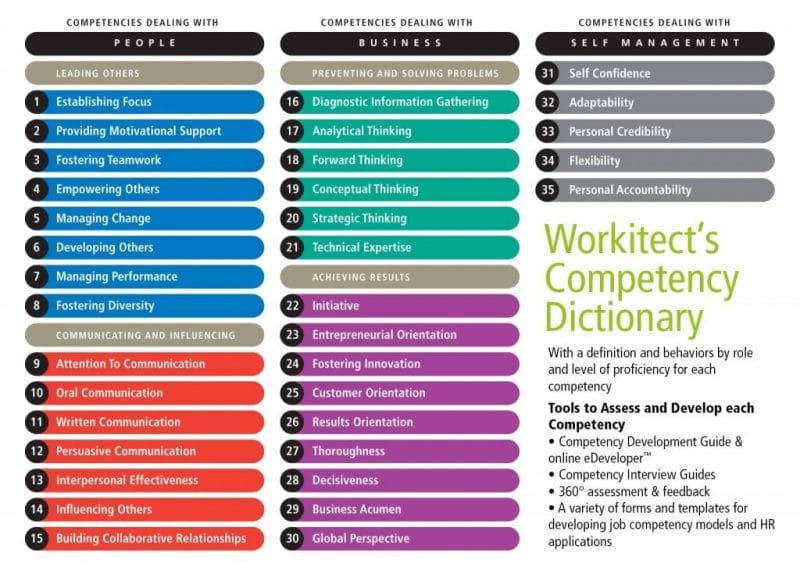 If research has shown that genetic patterns can be changed, given the right set of circumstances – incentive, understanding, conditioning and education – then organizations can indeed develop very effective leaders, with the right coaching, training curriculum, assessment processes, rewards program, and talent management systems.
When looking for a new leader, it is important to begin by defining the ideal leader for the role through a customized job competency model. This will help you accurately assess candidates based on both acquired competencies and the ability to learn new competencies, because remember that some self-management competencies such as Personal Credibility are difficult to be developed through a training program. It is therefore those individuals who already possess the characteristics that cannot be taught that are most likely to succeed.
For more information on leadership competencies or to get started on a leadership competency model, we invite you to use our Competency Dictionary and other competency development tools, or contact us for a private consultation.
 To learn more about our products and services, and how competencies and competency models can help your organization, call 800-870-9490, email edward.cripe@workitect.com
or use the contact form at Workitect.
©️2024, Workitect, Inc.
Tags: competencies, competency dictionary, job competencies, Leadership Competencies, talent management
Related Posts


Recent Posts

In Good Times & Tough Times, You Need Competent People
People. Not money, not buildings, not tools. Competent people are your most valuable resource. And…

What is the One-Size-Fits-All Competency Model?
In the One-Size-Fits-All Approach, a competency model is developed for a broadly defined set of…

Is Your Performance Management System Working?
If it isn’t working, consider a… COMPETENCY-BASED PERFORMANCE MANAGEMENT SYSTEM Many organizations are becoming…

The New Reality: Career Streams vs. Career Ladders
Along with many other changes in how employee performance is managed, there is a…