

How to Develop a Competency Model
Workitect’s methodology for building models is based on the original job competence assessment (JCA) methodology developed in the 1970’s by Dr. David McClelland, a pioneer in competency research and testing, and by consultants at McBer and Company.
Organizations that buy off-the-shelf models or use a methodology similar to that used to write job descriptions are missing out on the most significant benefit of competency models. Models customized to an organization are based on analyses of superior performers in that organization, with its unique culture, ways of doing business, and business strategy. These models paint a picture of what success looks like in that particular organization. Off-the-shelf models and those developed by sorting cards, brainstorming, or reading the latest business book cannot do that. This blog post describes how to develop a competency model following six steps used by Workitect to develop effective and reliable competency models.
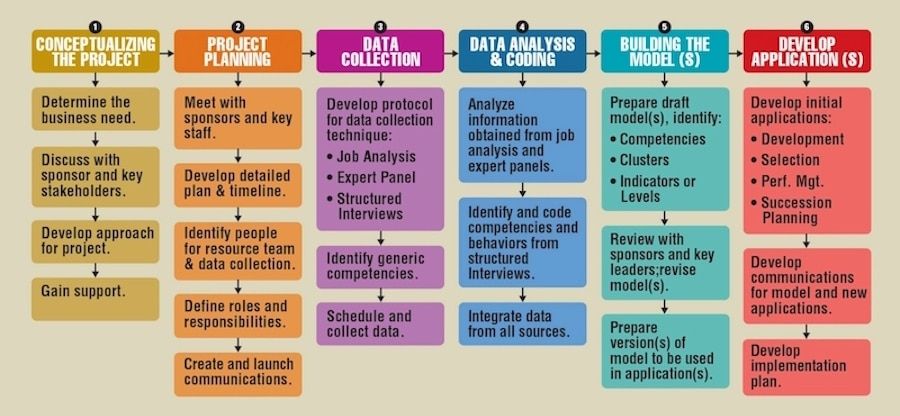
Previous blog posts have described steps 1 through 4 in Workitect’s competency modeling process.
Step 1 – Conceptualizing the Project
Step 2 – Project Planning
Step 3 – Data Collection
Step 4 – Data Analysis and Coding
Secondary Data Collection Methods
Conducting Behavioral Event Interviews
Using Resource/Expert Panels to Build Competency Models
General Approach for Analyzing Data to Build a Competency Model
Step 5 – Building the Model
After you have coded and analyzed data gathered from resource panels, interviews, and other methods, you are ready to build (write and complete) the competency model. If you are constructing one competency model, the process includes the following steps:
- Select a set of 8 to 15 competencies to include in the competency model.
- Select or create behavioral indicators for each competency.
- Identify 3 or 4 competency clusters and group the competencies within these clusters.
- Create a definition for each competency.
- Prepare a draft competency model.
- Have the sponsor and key stakeholders review the draft competency model.
- Revise the draft model to accommodate reasonable suggestions from the sponsor and stakeholders.
The first three of these steps are usually done at a meeting of the analysts. Each of the steps to develop a competency model will be described in detail in the sections that follow.
1. Select a Set of 8 to 15 Competencies to Include in the Competency Model
Why Should a Competency Model Have 8 to 15 Competencies
For most jobs, at least eight competencies are needed to capture the skills and personal qualities that contribute to superior performance. The more complex the job, the more competencies can be identified. But when there are more than 15 competencies, a competency model becomes difficult to use. For example, a competency assessment tool assessing 16 competencies with five items per competency would have 80 items – perhaps too many to rate in a reasonable amount of time. If the users of the competency model have a low tolerance for complexity, the number of competencies should be at the low end of the 8 to 15 range. If the users have a higher tolerance for complexity (for example, among engineers or scientists), the number of competencies can be at the high end of the same range.
Ways to Limit the Number of Competencies
For complex jobs, such as middle and senior management positions, it is often possible to identify 20 or more competencies that contribute to superior performance. But to ensure that the competency model is useful, it is necessary to limit the number of competencies. One way to do this is to remove and set aside competencies that would also be present in “feeder” jobs for the position under study. For example, when building a competency model for middle managers of engineers, you might remove Analytical Thinking and Managing Performance. Analytical Thinking would be needed in lower level engineering positions, and Managing Performance would be needed in first-level engineering management positions. Competencies removed in this way could either be eliminated completely from the competency model, or could be separately acknowledged as part of a set of “baseline” competencies for the position. It may be useful to identify and build applications for a set of baseline competencies, if many of the job-holders lack these competencies.
A second way to limit the number of competencies is to eliminate ones that appear less important in comparison to the others. For example, you could eliminate generic competencies that received fewer votes from the Resource Panel. If you conducted and coded Structured Event Interviews, the less important competencies include both ones occurring with low frequency among superior performers and ones occurring with similar frequency among outstanding performers and persons judged to be somewhat less effective.
A third way to limit the number of competencies is to combines ones that are conceptually related. For example, Interpersonal Effectiveness and Building Collaborative Relationships are conceptually related, because it usually takes some Interpersonal Effectiveness to build relationships. When combining competencies, you can retain one of the competency names while incorporating a few conceptually related behavioral indicators from the other competency.
2. Select or Create Behavioral Indicators for Each Competency
If a generic competency framework has been used, you can review the behavioral indicators for a competency and either use the entire set or select the behaviors which seem appropriate for the job being studied. Behavioral indicators are specific ways of demonstrating the competency in the job. If you want to create new or additional behavioral indicators, be sure that each one clearly describes a behavior that would clearly facilitate effective performance. Behavioral indicators should not describe people’s perceptions of the job-holder (e.g., “is widely respected”). Start each behavioral indicator with a verb. This is an example of behavioral indicators for the competency of Empowering Others:
Definition of Empowering Others: Conveying confidence in employees’ ability to be successful, especially at challenging new tasks; delegating significant responsibility and authority; allowing employees freedom to decide how they will accomplish their goals and resolve issues.
Behavioral Indicators
- Gives people latitude to make decisions in their own sphere of work
- Is able to let others make decisions and take charge
- Encourages individuals and groups to set their own goals, consistent with business goals
- Expresses confidence in the ability of others to be successful
- Encourages groups to resolve problems on their own; avoids prescribing a solution
If you conducted and analyzed Structured Event Interviews you may want to create some new behavioral indicators based on behaviors that did not fit any of the existing behavioral indicators in the generic competency framework.
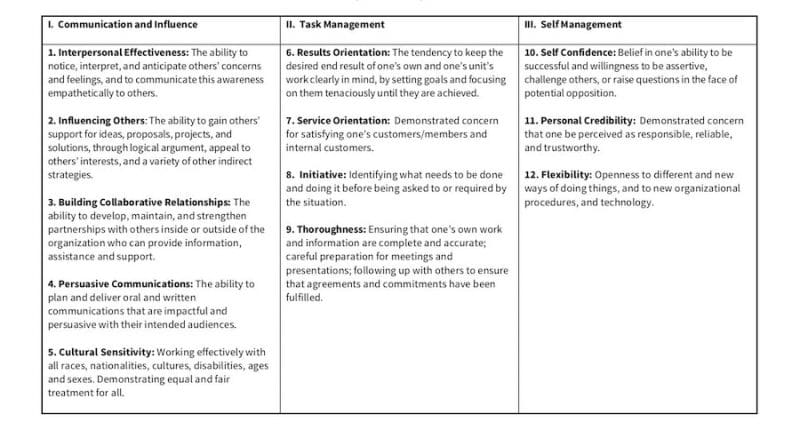
3. Identify 3 or 4 competency clusters and group the competencies within these clusters
Clustering the competencies helps people remember the competencies. It is difficult to read and understand a list of 12 competencies but easier to deal with three clusters of four competencies each. The cluster names should be conceptually clear, as in this example:
4. Create a definition for each competency
If you are using a generic competency framework, you can use the definitions from it, but you will need to create definitions for new competencies. You may want to revise the wording of the generic competencies, so that the definitions have high impact and use the language of the organization. This is especially true if you are developing a one-size-fits-all model that will be widely used in the organization.
Creating competency definitions is best done by persons who have reviewed the evidence from the data analysis and who are skilled at written communication. Here is an example of a competency definition that was created with the assistance of a professional writer.
Resilience: Complexity and change test the individual and the organization. When things don’t go as planned, leaders must stay focused and productive to bring others along with them.
5. Prepare a Draft Competency Model
Since key stakeholders in the model (e.g., job holders and their managers) will need to “buy in” to the competency model, it is useful to create a draft version of the competency model and have them review it. Here is a possible format for the draft competency model.
Page 1: The competency clusters with the competency names under each cluster
Page 2: The competencies with definitions, grouped by cluster
Page 3: Competency 1 followed by its definition and behavioral indicators.
Page 3.1 Competency 2 followed by its definition and behavioral indicators
6. Have the sponsor and key stakeholders review the draft competency model.
Review the draft competency model with the project’s sponsor first. If the sponsor approves, send the draft competency model to be reviewed by some of the people participated as Resource Panel members or interviewees. It may be desirable to reconvene the Resource Panel or to hold a conference call with panel members after they have had a chance to review the competency model.
7. Revise the draft model to accommodate reasonable suggestions from the sponsor and stakeholders.
The stakeholders often provide valuable input. For example, they may want to include a competency that you had eliminated because you thought it was less important than the ones you included. Try to accommodate reasonable suggestions, but resist making changes that violate the principles explained in this workbook.a
HOW TO DEVELOP A COMPETENCY MODEL: ADDITIONAL STEPS TO BE COVERED IN FUTURE BLOG POSTS
A. Special situations in building competency models:
– Working with Competency Levels
– Working within a framework of Core Competencies
B. Prepare version(s) of the model(s) to be used in application(s)
_____________________________________________________________________________
Learn More
Workitect’s six-step model building process is taught in the Building Competency Models certification workshop and practiced by Workitect consultants in the development of job competency models. Instruction on how to develop a competency model is also contained in the Quick-Start Competency Modeling program that is included with Competency Dictionary licenses.
Simplify the Development of Competency Models.
Use Customizable Tools to Simplify Implementation
Purchase Separately or as a Set
Utilize a comprehensive set of tools developed by Workitect. Each component is written in language that “makes sense” to people at all levels in an organization. You’ll save, time and money and have the confidence that your applications are based on tested, research-based content.
Each tool is derived from the 35 competencies in Workitect’s Competency Dictionary, and the competency models that are created. The Competency Development Guide and eDeveloper™ focus on ways to develop each of the 35 competencies. The Competency Interview Guides describe an interview process and interview questions for each competency. The 360° survey instrument provides assessment feedback for each competency.

To learn more about our products and services, and how competencies and competency models can help your organization, call 800-870-9490, email edward.cripe@workitect.com
or use the contact form at Workitect.
©️2019, Workitect, Inc.

Tags: competencies, competency, competency dictionary, competency modeling, competency models, framework, HR strategy, job competencies, modeling, models
Related Posts
Recent Posts

In Good Times & Tough Times, You Need Competent People
People. Not money, not buildings, not tools. Competent people are your most valuable resource. And…

What is the One-Size-Fits-All Competency Model?
In the One-Size-Fits-All Approach, a competency model is developed for a broadly defined set of…

Is Your Performance Management System Working?
If it isn’t working, consider a… COMPETENCY-BASED PERFORMANCE MANAGEMENT SYSTEM Many organizations are becoming…

The New Reality: Career Streams vs. Career Ladders
Along with many other changes in how employee performance is managed, there is a…