
Five Types of Competency Characteristics to Predict Future Success
There are many ways to define competencies but in sum, they can be referred to as the very characteristics causally related to criterion-referenced effective and/or superior performance in a job or situation.
Let’s note that a characteristic is not a competency, unless it predicts something meaningful in the real world, such as behavior or performance, hence the ‘causally related’ segment of our definition.
Psychologist William James said the first rule for scientists should be that “A difference which makes no difference is no difference.” A characteristic that makes no difference in performance is not a competency, and should therefore not be used to evaluate people. A competency must be a fairly deep and enduring part of a person’s personality, sufficiently so that it can be used to predict behavior in a wide variety of situations and job tasks.
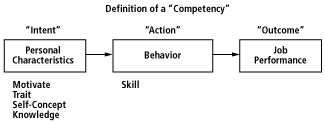
The causal relationship of competencies in job performance management can be illustrated as such:
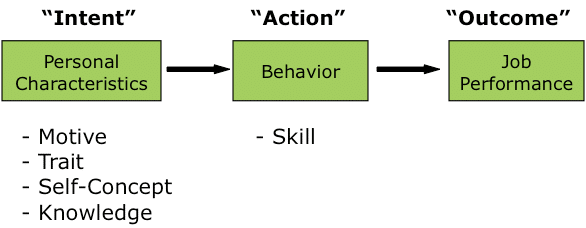 But a competency must also be criterion-referenced, which means that it actually predicts who does something well or poorly, as measured by a specific criterion or standard.
Depending on the performance criterion they serve to predict, competencies can be categorized as ‘threshold’, which refers to the basic essential skills that a person must possess to produce at least the minimal output required by a job role, or ‘differentiating’, which distinguish superior from average performers.
Here are 5 types of competency characteristics to understand, identify and measure in your workforce, in order to better assess your employees’ current and potential output.
1. Motive
Last month, we wrote about the importance for employers and managers to be able to determine motive in their staff, as they more accurately predict job performance thank acquired skills and education. The things a person consistently thinks about or desires are drivers of behavior and, ultimately, performance. They determine and explain a person’s actions in the workplace or in a given situation. For instance, achievement-motivated people consistently set challenging goals for themselves, take personal responsibility for accomplishing them, and use feedback to improve on a continuous basis. And while performance management supports the alignment of an individual’s professional development to overall corporate results, it must also factor in the motives behind this person’s actions to understand past behavior and provide the right incentives to superior future performance.
2. Traits
Traits are those consistent physical and behavioral responses to situations or information. For example, reaction time and good eyesight are physical trait competencies of combat pilots. In a 2013 research paper, Routledge reminds us that the extent to which traits actually translate into actual behavior depends, at least in part, on how structured or regulated the situation is. But to predict performance in a workplace environment, traits should be viewed as intrinsic behaviors that people will exhibit without close supervision. Bear in mind however that traits are closely correlated to motives. An individual may choose to activate the necessary traits for a job role at any specific moment, depending on their underlying motive. Since every position comes with behavioral expectations from management, an employee with the motive or aspiration to access higher roles within the organization could choose to develop or exhibit the very traits required to perform in this role, even if they are not aligned with their personal preferences.
3. Self-Concept
Self-concept refers to our personal attitudes, values and self-image. It is the belief of how effective we can be in a particular situation. Psychology tells us that there are four categories of self-concept: the perceived self, the ideal self, one’s self esteem, and a set of social identities. Each of these elements plays a crucial role in understanding how self-concept relates to energizing, directing, and sustaining organizational behavior. After all, a person’s values are respondent or reactive motives that predict what he or she will do in a situation. For example, someone who values being in management, but does not intrinsically like or spontaneously think about influencing others at the motive level, may attain a managerial position, but then fail. If self-concept is partly developed from feedback from others (the very feedback that is then used to shape a person’s actions and behaviors), effective managers know how to accurately identify their employees’ concepts of self in order to:
- Align these perceptions to the needs of the organization by assigning employees to the appropriate job tasks
- Provide the right feedback to help employees achieve their ‘ideal selves’ – the driver or motive to performance
This form of motivation, which is achieved through consistent feedback, rewards and incentives, serve to increase the probability of the expected behavior in the future.
4. Knowledge
Knowledge consists in the information a person has in specific content areas. While the definition may appear to be quite simple and straight forward, knowledge is a complex competency. Scores on knowledge tests often fail to predict work performance because they fail to measure knowledge and skills in the ways that are actually used on the job. Many knowledge tests measure remote memory, when what is really important is the ability to find information. Memory of specific facts is less important than knowing which facts exist that are relevant to a specific problem, and where to find them when needed. Knowledge at best predicts what someone can do, not what he or she will do. So once again, knowledge alone cannot accurately predict an employee’s output or performance but rather, it must be interpreted as part of a whole, along with motive, traits, self-concept and skills, to name a few. It refers to the basic requirements to attain a given job role, but cannot be the sole criterion to recruiting.
5. Skill
Skill is the ability to perform a certain physical or mental task. For example, a dentist’s physical skill to fill a tooth without damaging the nerve, or a computer programmer’s ability to organize 50,000 lines of code in logical sequential order. Mental or cognitive skill competencies include analytic thinking (processing knowledge and data, determining cause and effect, organizing data and plans) and conceptual thinking (recognizing patterns in complex data). We’ve already discussed the difference between skills and competencies; skills refer to a person’s ability to learn in order to accomplish a task. They are acquired through education and hard work, and can be regarded as somewhat tangible. Competencies extend a bit further to include the behaviors, motives and knowledge required to utilize those skills to produce the desired results. They can therefore be defined as a group of measurable traits that allow an organization to assess an individual’s probability of superior performance, with respect to the skills he/she already possesses. Like knowledge, skills are often perceived as the ultimate requirements to attain a given job role, but they do not guarantee future results.
Hitting the bull’s eye: A customized competency model to performance
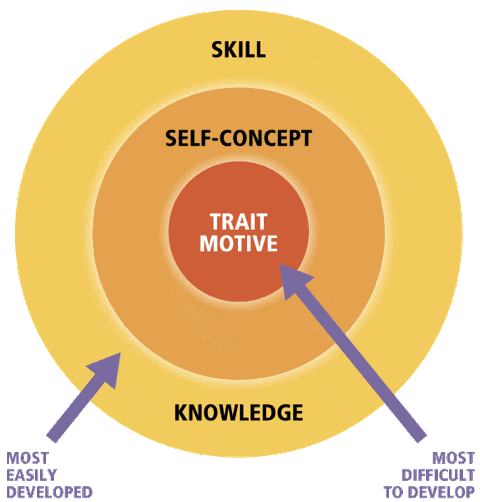 Building a competency model requires more than listing the traits or motives desired within a certain job role. An “off-the-shelf” model is likely to fail to recognize the unique aspects of your company’s unique strategy, culture and values. These generic tools are critical to the competency modeling process, as a starting point in your development process, but competency modeling should also look inward, at where your specific organization is, what it intends to accomplish, your competitive landscape, and the obstacles that may stand in your way over time.
We invite you to join us at any of our upcoming workshops to learn to develop a tailored competency dictionary, build a competency model in six steps, without external consultants, and adequately integrate off-the-shelf lists, such as PDI, Lominger, DDI, etc.
You will also learn how to successfully implement a sustainable competency system, which can be applied to almost every one of your HR processes, including succession planning, performance management, professional development, assessment, selection, retention, and many more.
Learn more here, or click here to register!
 To learn more about our products and services, and how competencies and competency models can help your organization, call 800-870-9490, email edward.cripe@workitect.com
or use the contact form at Workitect.
©️2019, Workitect, Inc.

Tags: competencies, competency dictionary, competency modeling, HR, interviewing, job competencies, McBer, personal characteristics, talent management
Related Posts
Recent Posts

In Good Times & Tough Times, You Need Competent People
People. Not money, not buildings, not tools. Competent people are your most valuable resource. And…

What is the One-Size-Fits-All Competency Model?
In the One-Size-Fits-All Approach, a competency model is developed for a broadly defined set of…
Is Your Performance Management System Working?
If it isn’t working, consider a… COMPETENCY-BASED PERFORMANCE MANAGEMENT SYSTEM Many organizations are becoming…

The New Reality: Career Streams vs. Career Ladders
Along with many other changes in how employee performance is managed, there is a…