Competencies in a Succession Plan
[fusion_builder_container type=”flex” hundred_percent=”no” equal_height_columns=”no” hide_on_mobile=”small-visibility,medium-visibility,large-visibility” background_position=”center center” background_repeat=”no-repeat” fade=”no” background_parallax=”none” parallax_speed=”0.3″ video_aspect_ratio=”16:9″ video_loop=”yes” video_mute=”yes” border_style=”solid”][fusion_builder_row][fusion_builder_column type=”1_1″ type=”1_1″ background_position=”left top” border_style=”solid” border_position=”all” spacing=”yes” background_repeat=”no-repeat” margin_top=”0px” margin_bottom=”0px” animation_speed=”0.3″ animation_direction=”left” hide_on_mobile=”small-visibility,medium-visibility,large-visibility” center_content=”no” last=”no” hover_type=”none” border_sizes_top=”” border_sizes_bottom=”” border_sizes_left=”” border_sizes_right=”” align_self=”center” min_height=”” link=””][fusion_text]
Include Competencies in a
Include Competencies in a
Succession Plan
Identifying Competency Requirements
Succession planning is an ongoing system of identifying competent employees who are ready to move into key jobs in the organization and/or those who, with specifically identified development, will be ready to assume key jobs at some stated point in the future. Job-person matches are made between existing employees and future jobs they might assume. These future jobs are usually higher level positions. But, succession planning may be for key jobs above, at the same level, or even below the job an employee now holds. Increasingly, succession planning is for lateral job moves (e.g., to a different function, project team, or geography).
The usual criteria for a succession planning system successful include:
- One, preferably two, well-qualified internal candidates are identified as ready to assume any key job should it become vacant.
- A record of successful promotions (or other job placements).
- Few superior performers leave the organization because of “lack of opportunity”
Competency-based succession planning systems identify the competency requirements for critical jobs, assess candidate competencies, and evaluate possible job-person matches. Career path “progression maps” identify key “feeder” jobs for lateral or higher level “target” positions within a job family or across job families.
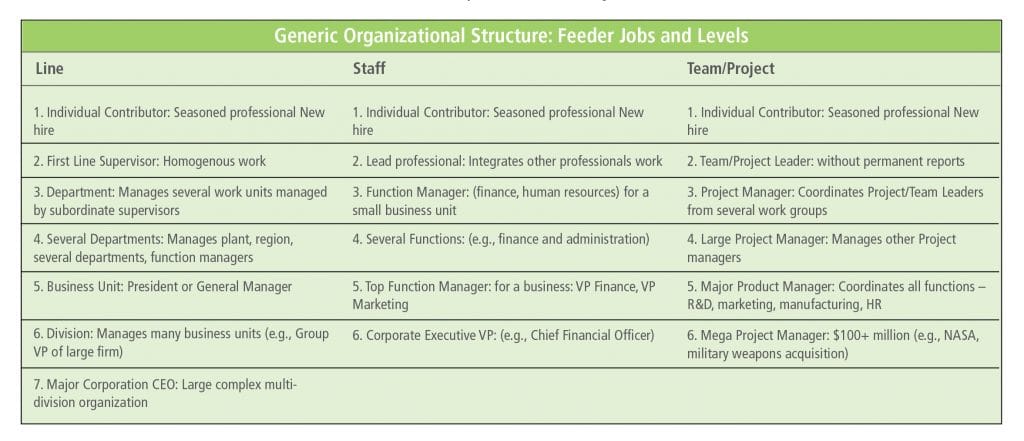
The table below shows seven generic levels for line, staff function, and team/ project management. Jobs at any given level are feeder positions for higher rungs on the job ladder, and for lateral moves to positions in other job families.
A competency-based succession planning system assesses how many employees in which feeder jobs have (or have the potential to develop) the core competencies to perform well in key target jobs. There are two ways of doing this.
- The first is to compare the core competencies of people in the feeder job with the competency requirements of the target job.
- The second is to compare the competency requirements of the feeder job and the target job.
Organizational Issues
The issues that indicate a need for competency-based succession planning systems include:
- Promotion or placement outcomes are poor; too many people promoted or transferred to new responsibilities fail or quit. Typical examples are promoting the best salesperson to sales manager or the best technical professional to supervisor and then finding he or she lacks essential interpersonal understanding and influence skills.
- There is a need to redeploy technical/professional staff people to marketing or line management jobs-or managers back to individual contributor roles in an organization that is cutting middle management. “Lean and mean” organizations offer fewer vertical promotional or career path opportunities, with the result that more succession planning is In downsizing organizations, the key placement question may be which managers have kept up with their technical and professional competencies so they are able to return to individual contributor roles.
- Organizational changes require employees with different competencies. Globalizing firms need employees with the competencies to function in different parts of the world. Privatizing organizations need to determine which government bureaucrats have enough achievement motivation to become entrepreneurs and businesspeople. Stagnant firms need employees with innovative and entrepreneurial competencies to survive in markets with shorter product life cycles and fast-moving foreign competitors. Downsizing firms need to decide who stays and who is let go, that is, which employees have the competencies to fill demanding “same amount of work with fewer people” jobs in the new, smaller organization.
- Mergers, acquisitions, and reorganizations require the surviving firm to decide which existing employees are needed for (which) jobs in the new structure. Mergers of similar firms often result in an organization with two marketing departments, two sales forces, duplicate staffs in many functions; merger efficiencies come from elimination of the double As with downsizing organizations, the question of who stays and who goes is determined by which employees have the competencies to succeed in the firm’s future jobs.
STEPS IN DEVELOPING A COMPETENCY-BASED TALENT MANAGEMENT SYSTEM
- Identify Key Jobs. Identifying these jobs in the organization’s structure – or the structure it wants for the future usually includes identifying the firm’s strategy, its critical value-added target jobs, and key feeder jobs to these target jobs. Most organizations will have some variant of the seven levels shown in Table 1 for line, technical/professional, or functional staff, and team/project manager job families. Vertical progression in a job family is:
– Individual contributor, often divided into two subgroups: new hire and seasoned professional
– First-level functional supervisor, managing a homogeneous group of individual contributors (e.g., a move from engineer to chief engineer or programmer to software development team leader). For functional technical/professionals and project job families, this level may be a lead professional who acts as a temporary team leader, assists and integrates other professionals’ work, and mentors junior employees, but does not have any permanent reports.
– Department, function or project managers, who manage supervisors or lead professionals of several work groups. - Develop Competency Models for Critical Target and Feeder Jobs. Frequently this involves development of competency models for each of several steps in a job family ladder. BEIs conducted with four superiors and two averages at each level are analyzed to identify competencies required for a superior performance at the level and also to pinpoint how the competencies change or grow as an employee advances up the ladder.
- Create a Formalized Succession Planning Process. This process should be an annual cycle that requires management at each level to conduct assessments and engage in discussions about the talent within their organizations including performance and potential of their direct reports and other high potential people within their groups. In addition a mid-year update meeting can be help to identify progress since the last formal session. During the annual session the management team classifies people, in terms of their performance and potential, as:
- Promotable, either:
- Ready now, or
- Developable (i.e., could be ready in the future if they develop specific competencies to the level required by the future jobs for which they are candidates)
- Not promotable :
- Competent in their current job, and/or
- Have potential to transfer laterally to some other job
- Not competent in their current job and not a fit with other jobs in the organization as it will be in the future. These people are candidates for early retirement or outplacement.
4. Develop a Human Resource Management Information System. Succession planning for more than a few positions all but requires a computerized human resource information system to keep track of the competency requirements of all jobs, competencies of these people assessed, and evaluation of possible job-person matches.
5. Develop a Development/ Career Pathing System (Optional). Succession planning systems create demand for competency-based development and career pathing systems. Once employees understand the competency requirements for higher jobs and the gaps between their competencies and those required by the jobs they want, they ask for training or other developmental activities to close the gap. Similarly, once an organization is aware of the competencies it needs to be successful and the gaps between these needs and the capabilities of its existing or projected staff, it seeks selection or developmental programs to close these gaps.
Using the Workitect Competency Dictionary
You can simplify and accelerate the planning process by using a competency dictionary or library of core competencies and leadership competencies, provided in a format that can easily be modified to better fit an organization. There is complete flexibility to use in any application: performance management, succession planning, 360° instruments, and other HR applications. And can be integrated into any HRIS system.
The dictionary consists of thirty-five competencies with definitions and behaviors, described in levels by job role (professional/specialist > supervisor/manager > director/executive) and levels of proficiency (basic > proficient > advanced).
Workitect consulting services are available to create competency-based succession planning and talent management systems. Contact us.
Related Posts
Succession planning strategy can hurt company competitiveness
Competency Models for Succession Planning
Selecting for Success: Succession Planning
Reference: Competence At Work, by Lyle Spencer and Signe Spencer; 1993, John Wiley & Sons.
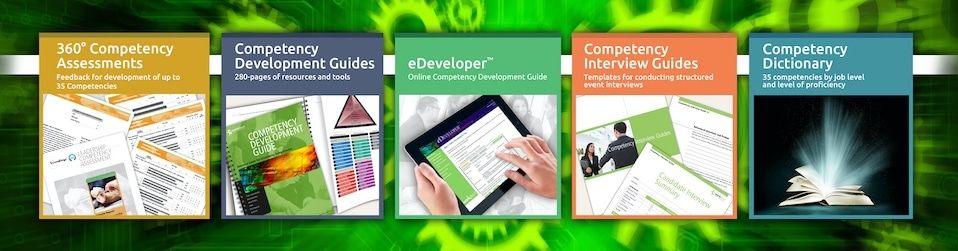
CREATE A COMPETENCY FRAMEWORK WITH THIS INTEGRATED SET OF
COMPETENCY-BASED TALENT MANAGEMENT TOOLS
 To learn more about our products and services, and how competencies and competency models can help your organization, call 800-870-9490, email edward.cripe@workitect.com
or use the contact form at Workitect.
©️2021, Workitect, Inc.


Tags: assessment, business strategy, Career Planning, competencies, competency modeling, competency models, competency system, core competencies, HR strategy, job competencies, leadership assessment development, succession planning, talent, talent management, talent strategies, workforce planning
Related Posts
Recent Posts

In Good Times & Tough Times, You Need Competent People
People. Not money, not buildings, not tools. Competent people are your most valuable resource. And…

What is the One-Size-Fits-All Competency Model?
In the One-Size-Fits-All Approach, a competency model is developed for a broadly defined set of…

Is Your Performance Management System Working?
If it isn’t working, consider a… COMPETENCY-BASED PERFORMANCE MANAGEMENT SYSTEM Many organizations are becoming…

The New Reality: Career Streams vs. Career Ladders
Along with many other changes in how employee performance is managed, there is a…