
Build or Buy a Generic Competency Dictionary?
[fusion_builder_container hundred_percent=”no” equal_height_columns=”no” hide_on_mobile=”small-visibility,medium-visibility,large-visibility” background_position=”center center” background_repeat=”no-repeat” fade=”no” background_parallax=”none” parallax_speed=”0.3″ video_aspect_ratio=”16:9″ video_loop=”yes” video_mute=”yes” border_style=”solid” flex_column_spacing=”0px” type=”legacy”][fusion_builder_row][fusion_builder_column type=”1_1″ layout=”1_1″ background_position=”left top” background_color=”” border_color=”” border_style=”solid” border_position=”all” spacing=”yes” background_image=”” background_repeat=”no-repeat” padding_top=”” padding_right=”” padding_bottom=”” padding_left=”” margin_top=”0px” margin_bottom=”0px” class=”” id=”” animation_type=”” animation_speed=”0.3″ animation_direction=”left” hide_on_mobile=”small-visibility,medium-visibility,large-visibility” center_content=”no” last=”true” min_height=”” hover_type=”none” link=”” first=”true”][fusion_text]
If you have decided to build competency models and/or include competencies in your HR applications, you will need to choose a method to use in building the models. Whatever method you choose, it will be much easier and faster to be able to draw on a list of specific competencies to include in each model. This list is also known as a generic competency dictionary or library. The alternative is to create the competencies as you develop each model. In this blog, we review three options for acquiring or developing a generic competency dictionary.
___________________________________________________________________________
Competencies are:
Competencies are the skills and behaviors that outstanding performers demonstrate more often, more skillfully, and with better results than do average performers.
This is an example of a competency:
Empowering Others
Definition: Conveying confidence in employees’ ability to be successful, especially at challenging new tasks; delegating significant responsibility and authority; allowing employees freedom to decide how they will accomplish their goals and resolve issues.
Behavioral Indicators (specific ways of demonstrating the competency in the job)
- Gives people latitude to make decisions in their own sphere of work
- Is able to let others make decisions and take charge
- Encourages individuals and groups to set their own goals, consistent with business goals
- Expresses confidence in the ability of others to be successful
- Encourages groups to resolve problems on their own; avoids prescribing a solution
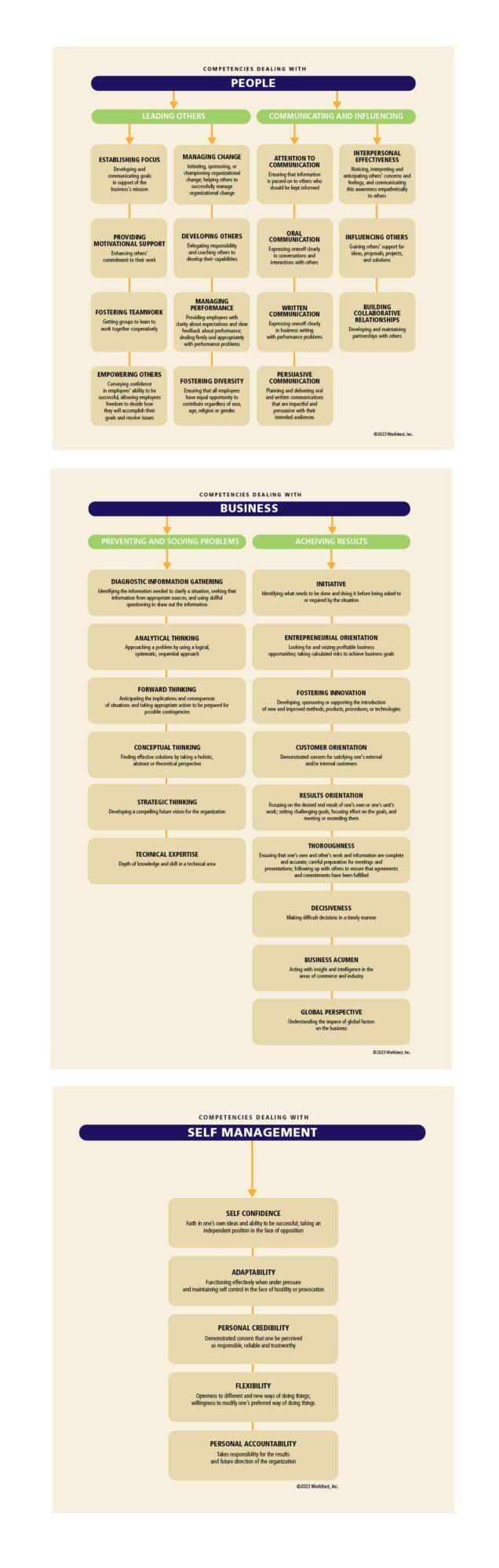
A generic competency dictionary would contain a list of competencies, each described similar to the Empowering Others example shown above.
Competency Models
A model is a group of related competencies that together describe successful performance for a particular job or role, in a particular organization. Most models contain 8-15 competencies. Here are some examples.
- Account Representative (Distribution company)
- Executives (Manufacturing company)
- Marketing Representative (Insurance company)
- Project Manager (High technology company)
_____________________________________________________________________________
Options for Acquiring a Competency Dictionary/Library
1. DEVELOP YOUR OWN COMPETENCY DICTIONARY – LIBRARY
You can develop your own models and a dictionary that includes using a list of specific competencies that you have developed on your own, possibly drawing on research on existing libraries.
Advantages:
- Total flexibility on what competencies to select and how to describe them.
- Out-of-pocket cost less than purchasing from most outside dictionary developers/licensors.
- Will be tailored to your organization and use your organization’s language. More relevant to the organization’s unique environment.
- Employees may be more committed to a competency model if they have been deeply involved in its development, and development of the dictionary.
Disadvantages:
- Lack of research, testing, practical use, and validity.
- Difficulty in clearly describing behavioral indicators of each competency.
- May inadvertently reference copyrighted competency dictionaries and violate legal copyrights, incurring dollar penalties and negative publicity for the company. May violate ethics values and rules.
- High total costs when factoring in amount of staff time and pay of developers.
2. PURCHASE A COMPETENCY DICTIONARY – LIBRARY
From a large consulting firm such as Korn Ferry, HRSG, et al.
Advantages:
- Capitalizes on the experience gained in other competency modeling projects, either in other companies or elsewhere in the same organization.
- Incorporates research across multiple industries and organizations.
- Comprehensive, large number of competencies (60 +)
- Software that may integrate with other HRIS.
- Efficiency – ensures consistency of competency language across an organization and that all potentially relevant competencies are considered
- Can provide an excellent starting point in development of an organization’s competency model.
- Large number of sales representatives to service accounts.
Disadvantages:
- High initial cost plus high annual renewal fees.
- Difficult and expensive to customize.
- Seen by users as too complex or academic, not “real-world”, and difficult to understand and use.
- Support from vendor to create models and applications, or train organization to build own models is expensive or non-existent.
- Not tailored to the organization and use the organization’s language.
- May not be effectively used to create competency models and included in applications.
- Organizational members may not be as committed to a competency model if they have not been deeply involved in its development.
3. PURCHASE WORKITECT COMPETENCY DICTIONARY – LIBRARY
Advantages:
- Low one-time fee. No annual renewal fees.
- Capitalizes on the experience gained in other competency modeling projects, either in other companies or elsewhere in the same organization.
- Incorporates research across multiple industries and organizations. Used by more than 100 organizations of all sizes and industries.
- Methodology for the building of competency models and development of the dictionary is based on the Job Competence Assessment (JCA) methodology developed by Dr. David McClelland, a pioneer in motivation and competency research and testing at Harvard, and consultants at McBer and Company.
- Simpler, manageable 35 foundational (leadership, management, and professional) competencies, with definition and behavioral indicators by three role levels (Executive/Director- Manager/Supervisor-Professional/Specialist) and three levels of proficiency (Basic-Skilled-Expert)
- Practical, tested, flexible (not software), easy to customize and tailor, e.g. modify title, add competencies.
- Can be integrated into any HRMS
- Efficiency – ensures consistency of competency language across an organization and that all potentially relevant competencies are considered
- Can provide an excellent starting point in development of an organization’s competency model,
- Instruction on how to use dictionary to build models with the help of a dictionary.
Quick-Start Competency-Modeling instructional program plus 12 model templates, and the Building Competency Models 3-day certification workshop - A low-cost integrated talent management package is available. It includes Competency Interview Guides, Competency Development Guides, and 360° feedback assessments for the same 35 competencies.
Disadvantages
- Workitect is a small firm with no regional sales representatives. Support is provided by four senior consultants. (Can be viewed as an advantage!).
- Integration with an organization’s HRMS (built internally or by vendor) requires IT assistance.
- May require extra effort to “sell” Workitect and our approach because our name may not be as familiar to executives as are larger consulting firms that also provide executive search services
 You are invited to join a LinkedIn group that I manage, Competency-Based Talent Management https://www.linkedin.com/groups/3714316 Our members would welcome your involvement in the group.
Sign up to receive the Workitect E-Newsletter. Get valuable news, insights and practical knowledge sent to you every month. Workitect Blueprints keeps you informed about key issues facing today’s organizations—from producing superior leaders to creating superior organizations. Sign up here!

For additional information, call 800-870-9490, email edward.cripe@workitect.com
or use the contact form at Workitect.
©2021, Workitect, Inc.
[/fusion_text][/fusion_builder_column][/fusion_builder_row][/fusion_builder_container]
Tags: competencies, competency dictionary, competency library, competency modeling, competency models, competency system
Related Posts
Recent Posts

In Good Times & Tough Times, You Need Competent People
People. Not money, not buildings, not tools. Competent people are your most valuable resource. And…

What is the One-Size-Fits-All Competency Model?
In the One-Size-Fits-All Approach, a competency model is developed for a broadly defined set of…
Is Your Performance Management System Working?
If it isn’t working, consider a… COMPETENCY-BASED PERFORMANCE MANAGEMENT SYSTEM Many organizations are becoming…

The New Reality: Career Streams vs. Career Ladders
Along with many other changes in how employee performance is managed, there is a…