
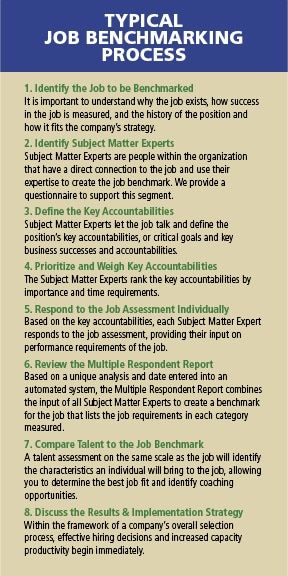
Benchmarking is not Competency Modeling
Human capital management is a relatively new science, but there is no denying that this practice has made tremendous progress over the past few decades, particularly in terms of recognition and efficiency within a greater organizational context.
Modern scientific advances, namely within the fields of behavioral and cognitive psychology, have helped support the development of many human resources theories that sought to establish a pattern to building and managing a workforce in a manner that sought to produce continuously superior results.
Of all the human resources theories to emerge over the years, competency modeling and benchmarking have probably been some of the most scrutinized. Strangely, it appears that the two schools of thought have grown to oppose each other, as if one couldn’t exist alongside the other.
But could it be that rather than taking sides, HR professionals – and consequently, organizations at large – could stand to gain by incorporating both approaches into their practices?
Let’s take a closer look.
Benchmarking, or the ‘grass is always greener’ theory
The Global Benchmarking Network characterizes benchmarking as “the systematic search for efficient procedures and better solutions for complicated problems and processes.”
Under a more generic definition, benchmarking could be defined as the comparative study of processes within a precisely segmented group to identify best practices. Let’s remember that benchmarking can be external or internal, meaning that the group under review could range from an entire industry to an organization’s own branches, departments or teams.
Regardless of the group surveyed, the objective of benchmarking is to allow an organization to measure its ‘relative success’ as a means to improve and, ultimately, optimize its results.
Within an HR framework, we find that the most common metrics measured through benchmarking are recruitment costs, compensation, training expenses, and turnover. For example:
- What is the lowest/average cost per hire within my industry?
- How are my competitors achieving better results?
In this case, you are benchmarking your cost per hire to your competitors, and attempting to gather data to understand what they are doing to outperform you so that you can improve.
Looking inward: A customized approach to performance
Then, at what many believe to be the other end of the spectrum, we find competency modeling, which refers to the development of groups of related competencies that together describe successful performance, within a given job context – e.g., the competencies necessary to achieve superior performance in a senior production management role within the textile industry.
It is important to note that the term ‘competencies’ includes knowledge, skills, behavior, personal characteristics, interests and values – all of which combine to set the standard against which to measure an individual’s chances of success within a specific job role.
The fact that competency models can be used to assess a worker’s potential in a particular position has often led to the assumption that competency modeling mainly served recruiting purposes. Yet, in reality, these models carry a much broader definition, and can be applied to a variety of organizational processes (succession planning, performance management, training and development, compensation, etc.).
Much like benchmarking, the metrics obtained from competency modeling are the result of empirical and comparative studies based on a segmented group’s best practices; the exception being that competency models tend to be more focused on the performance metrics of the people behind the processes, rather than the processes themselves.
Understanding this difference is key to grasping the full potential of integrating competency models with a benchmarking approach.
Power to the people…or processes? The chicken-egg paradox
While the intent of this article isn’t to argue which is more important: the process or the people implementing the process, it is nevertheless imperative to understand that even the most optimal process can fail if the people responsible for its execution do not possess the skills to implement it as intended. Similarly, even the most qualified executives may not deliver the intended results if the processes they must apply are not optimized for performance.
Acknowledging that both people and processes are instrumental to a company’s success makes it much easier to see how benchmarking and competency modeling can work together to provide an invaluable competitive edge for any organization.
Benchmarking can be an important component to optimizing organizational output, as it gathers data about the competitive landscape. But once you have become aware of your industry’s best practices, you need a strategic plan to not only replicate them internally, but hopefully also to build upon them to eventually set the bar within your sector.
Here’s where the input of benchmarking can be used.
Competency modeling can use the data gathered through benchmarking to develop models of superior performance that are customized to your organization’s unique descriptors, characteristics and goals.
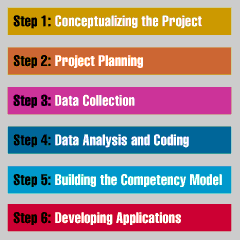 In step 3 of Workitect’s competency modeling process*, it is necessary to identify the superior performers in a job for which the model is being developed, and then collect data to determine the skills, knowledge, and personal characteristics of those superior performers. One of the methods used to identify the top performers and collect data is a resource panel, also known as an expert panel. In addition to studying people who are top performers today, the panel needs do a “future scan” to:
- Identify ongoing or anticipated changes in the organization, industry, and relevant technology that may affect the job
- Identify what each change implies, in terms of additional skills and personal characteristics that job incumbents will need
To illustrate more specifically to a job role, benchmarking would allow you to identify the best practices with respect to a CFO’s duties (key tasks and performance measures), while a job competency model will use the data gathered to identify the skills, knowledge, and personal characteristics required to perform these key tasks as intended, at the most cost-effective ratio for your organization, in accordance with your constraints.
*The building of job competency models, making use of benchmarking data, is included in Workitect’s Building Competency Models certification workshop.
 To learn more about our products and services, and how competencies and competency models can help your organization, call 800-870-9490, email edward.cripe@workitect.com
or use the contact form at Workitect.
©️2019, Workitect, Inc.

Tags: benchmarking, competency modeling, HR, job competencies, performance management, talent management
Related Posts
Recent Posts

In Good Times & Tough Times, You Need Competent People
People. Not money, not buildings, not tools. Competent people are your most valuable resource. And…

What is the One-Size-Fits-All Competency Model?
In the One-Size-Fits-All Approach, a competency model is developed for a broadly defined set of…
Is Your Performance Management System Working?
If it isn’t working, consider a… COMPETENCY-BASED PERFORMANCE MANAGEMENT SYSTEM Many organizations are becoming…

The New Reality: Career Streams vs. Career Ladders
Along with many other changes in how employee performance is managed, there is a…