
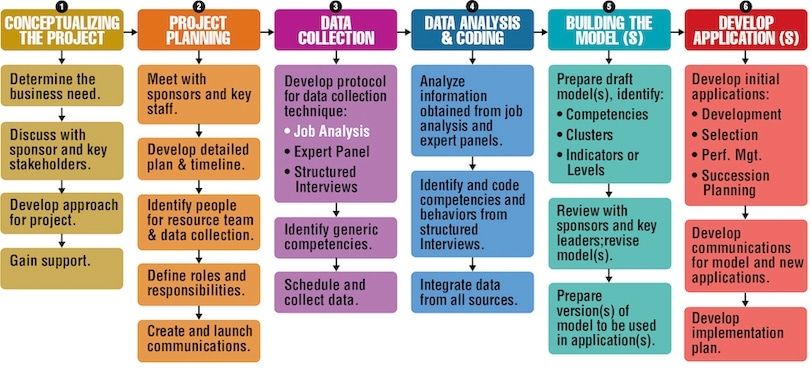
General Approach for Analyzing Data to Build a Competency Model
[fusion_builder_container type=”flex” hundred_percent=”no” equal_height_columns=”no” hide_on_mobile=”small-visibility,medium-visibility,large-visibility” background_position=”center center” background_repeat=”no-repeat” fade=”no” background_parallax=”none” parallax_speed=”0.3″ video_aspect_ratio=”16:9″ video_loop=”yes” video_mute=”yes” border_style=”solid”][fusion_builder_row][fusion_builder_column type=”1_1″ layout=”1_1″ background_position=”left top” border_style=”solid” border_position=”all” spacing=”yes” background_repeat=”no-repeat” margin_top=”0px” margin_bottom=”0px” animation_speed=”0.3″ animation_direction=”left” hide_on_mobile=”small-visibility,medium-visibility,large-visibility” center_content=”no” last=”true” hover_type=”none” min_height=”” link=”” background_blend_mode=”overlay” first=”true”][fusion_text]
Analyzing Data from Job Analysis Interviews
STEP 4 – DATA ANALYSIS AND CODING
Previous blogs have described steps 1 through 3 in Workitect’s competency modeling process. Step 3, Data Collection, was covered in these blogs:
Collecting Data to Build Competency Models
Secondary Data Collection Methods
Conducting Behavioral Event Interviews
Using Resource/Expert Panels to Build Competency Models
The general approach for analyzing the data collected in step 3 has three steps:
- Reviewing/modifying a set of generic competencies that will be used as the conceptual framework guiding the analysis.
- Separately reviewing the evidence from each data collection method to identify a potential set of competencies, drawn from the generic competency framework.
- Reviewing and comparing the evidence across methods to identify a set of potential competencies to include in the competency model.
Each of these steps is described below. Note that the
Data analysis ends with identifying a potential set of competencies to include in the competency model.
Moving from that step to building the actual competency model will be described in a separate blog.
Reviewing/Modifying a Set of Generic Competencies to Include in the Competency Model
If you are using a Multiple Jobs Approach to building the competency model, you will have already identified a set of generic competencies to serve as building blocks for the various competency models you are planning. If you are using the Single Job Approach or the One Size Fits All Approach, you may have used a set of generic competencies that were rated by a Resource Panel or by persons with whom you did Job Analysis Interviews. If, by chance, you have not yet begun to use a set of generic competencies, now is the time to start, because a framework of generic competencies is useful in guiding the analysis.
You will not necessarily end up with competencies as they appear in the initial generic competency framework. You may identify and add competencies that were not initially part of the framework. You may modify some of the competencies from the initial framework. But using the framework will facilitate the analysis of the data.
Based on the experience of collecting the data, you may already have some ideas about competencies that need to be added to the framework. For example, if you are preparing a competency model for Project Managers, you may have decided to add Project Management Knowledge to the framework as a technical skill/knowledge competency. It may be clear that the wording used to describe certain competencies can be improved by substituting language that better fits the job or organization. For example, if the organization in which you are working uses the term, “Driving Innovation” instead of “Managing Change,” you may want to change the competency name accordingly
If it is clear at the start of the data analysis process that changes like these will be needed, you might as well modify the generic competency framework now, so that you can look for and track evidence for these new or modified competencies during the analysis process. It will still be possible to modify generic competencies and add new competencies later on.
Separately Reviewing the Evidence Generated from Each Data Collection Method, to Identify a Set of Potential Competencies Drawn from the Generic Competency Framework
In this step you separately review the evidence from each of the data collection methods that you used – Job Analysis Interviews, for example – and try to answer the following question: Based on this data collection method alone, which competencies should be considered for inclusion in the competency model?
In carrying out this analysis, you may encounter direct evidence for certain competencies from the generic competency framework. For example, all or most of the participants at a Resource Panel may select a competency for inclusion in the competency model. Or, when analyzing Structured Interviews with superior performers, you may find that their descriptions of their behavior during key past events include many examples of some competency.
But your analysis may also reveal indirect evidence that a competency is important. For example, if you learn that an important task for sales representatives is to deliver formal and informal presentations to clients, this task implies the need for the competency, Persuasive Communication. Or if you learn that a key performance measure for a job is Customer Satisfaction, this implies the importance of the competency, Customer Orientation.
Review and Compare the Evidence Across Methods to Identify a Set of Potential Competencies to Include in the Competency Model
Although there will be some overlap in the competencies that are suggested by each data collection method, there will probably be some differences, at least in emphasis. Job Analysis Interviews with managers of persons in the job may lead to the identification of competencies that are most important and visible to the job holders’ managers. Interviews with customers of the job holders will highlight competencies that are most visible and important to customers. Structured Event Interviews may reveal thought processes that lead to the identification of competencies such as Conceptual Thinking that are not as likely to be surfaced through other data collection methods.
One way to compare the competencies revealed by different methods is to construct a matrix of generic competencies by methods, like the one below. You can omit generic competencies that are not identified as important in the analysis of any of the data gathering methods that you used. In each cell, use H, M, or L to indicate whether the competency seems high, medium or low in importance, based on data from this method. In the Overall column, make a judgment about the importance of including this competency in the competency model. You do not need to weight each data collection method equally.
| Generic Competency | Job Analysis Interviews with Incumbents | Resource Panel | Structured Event Interviews | Overall |
| 1. Establishing Focus | H | H | H | H |
| 2. Providing Motivational Support | M | H | M | M |
| 3. Fostering Teamwork | L | M | M | M |
AN OVERVIEW OF METHODS FOR ANALYZING DATA GATHERED DROM INDIVIDUALS
Details of this process, and instruction on analyzing and coding the data collected in step 3, are provided in the Workitect Building Competency Models workshop and practiced by Workitect consultants in the development of job competency models.
Analyzing Data from Job Analysis Interviews
Analyzing Data from Resource Panels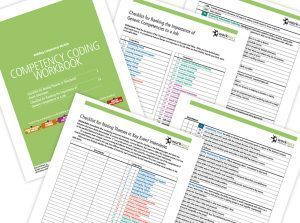
Analyzing Data from Structured Event Interviews
General Principle 1. Recognize Target Data
Target Data is defined as behaviorally specific information, volunteered by the interviewee in response to non-leading questions, about what the interviewee did, said, thought, or felt in one specific past situation.
General Principle 2. Focus on Effective, Impressive Behavior
General Principle 3. Code Against the Generic Competencies and Their Behavioral Indicators
This is one approach to implement coding:
A Simple Coding Process Using a Checklist
We have developed a simple coding process that is appropriate if you are doing a small number of Structured Event Interviews with superior performers and want to use the interviews to help identify behavioral indicators used by these persons.
This coding process involves using a checklist based on the framework of generic competencies and their behavioral indicators.
Reviewing and Analyzing Other Data
Survey Data, Customer Interviews, Observational Data
Details of this process, and instruction on analyzing and coding the data collected in step 3, are provided in the Workitect Building Competency Models workshop and practiced by Workitect consultants in the development of job competency models.
Instruction on developing competency models is also contained in the Quick-Start Competency Modeling program that is included with Competency Dictionary licenses.
 To learn more about our products and services, and how competencies and competency models can help your organization, call 800-870-9490, email edward.cripe@workitect.com
or use the contact form at Workitect.
©️2023, Workitect, Inc.
[/fusion_text][/fusion_builder_column][/fusion_builder_row][/fusion_builder_container]
Tags: coding data, competencies, competency dictionary, competency modeling, competency models, expert panel, framework, interviews, modeling
Related Posts
Recent Posts

In Good Times & Tough Times, You Need Competent People
People. Not money, not buildings, not tools. Competent people are your most valuable resource. And…

What is the One-Size-Fits-All Competency Model?
In the One-Size-Fits-All Approach, a competency model is developed for a broadly defined set of…
Is Your Performance Management System Working?
If it isn’t working, consider a… COMPETENCY-BASED PERFORMANCE MANAGEMENT SYSTEM Many organizations are becoming…

The New Reality: Career Streams vs. Career Ladders
Along with many other changes in how employee performance is managed, there is a…