“Workitect consultants provide advice that will benefit your entire HR process from recruiting and performance management to succession planning.”
Engineering Company


COMPETENCIES
“How” of performance
More qualitative
Longer time frame: Future
Performance in present and future jobs
Development (behavior change)
PERFORMANCE
“What” of performance
Quantitative: Tied to unit goals
Short time frame: One year,
Past performance
Reward oriented
We Help Organizations:
Many organizations are becoming more interested in management and appraisal of competence – the “how” of performance. They are seeking more qualitative assessment, oriented to the future and focused on development. A competency-based approach brings a different perspective to performance management. Performance is viewed in terms of the process employees use to achieve their job results. It combines planning, management, and appraisal of both performance results and competency behaviors. It assesses what employees accomplished and how they did it (with personal characteristics they possess that predict superior performance in present jobs, or in future jobs).
Performance and competence are balanced in a competency-based performance management system. In a line job, achievement of performance results may be weighted 80-90 percent and demonstration of competency behaviors only 10-20 percent. At the other extreme, an appraisal form for a service position might weight competence 100 percent. Performance objectives for a staff job might give equal weight to results and demonstration of competency behaviors.
In traditional systems, achievement of performance results is quantified, past oriented, and tied to unit goals, based on a short term, and used to make compensation decisions. Competency appraisal is more qualitative, longer range, future oriented, and used for employee development and career path planning.
PERFORMANCE
(“pay for results”)
50%-90%
COMPETENCIES
(“pay for skill”)
10%-50%
Competency-based performance management systems shift the emphasis of appraisal from organization results achieved to employee behaviors and competencies demonstrated. Diagnosis and problem solving to deal with poor performance takes this form: “If results are not at the desired level, give higher priority to these job tasks, demonstrate these behaviors more often, and develop these competencies” (i.e., model the task priorities, behaviors, and competency levels of the best performers in the job).
An important factor in implementing a competency-based performance management system is the training of managers to provide coaching and developmental assistance. (Studies of effective performance management systems consistently find training to be an important input.) Employee training also helps employees understand how the system works, what their role is, how to assess themselves, and how to contract for competency development activities with their managers.
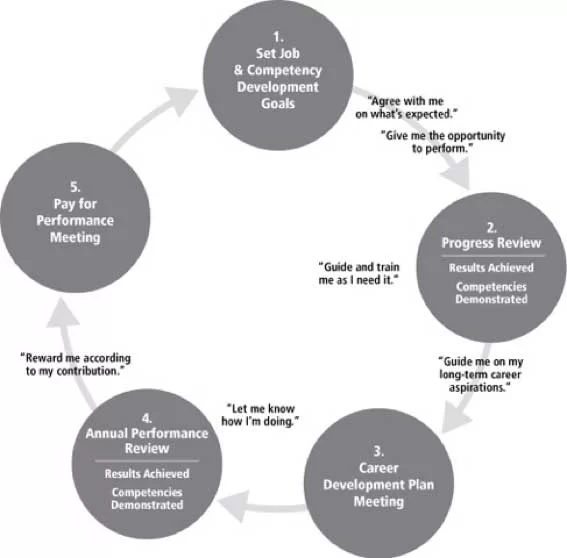
From an employee’s perspective, performance management involves five steps, as shown in the above illustration. Step 1 is to write your job goals and develop appropriate action plans. Step 2 gives you the chance to review your progress with your supervisor so he/she can let you know how well you are doing, allowing him/her to guide and coach you as needed. Step 3 is where career development plans are discussed. Step 4 is the quarterly or annual performance review, where your overall job responsibilities and achievements are evaluated. Step 5 is a discussion of pay decisions related to your performance.
Our Performance Planning and Review booklet covers these steps in more detail. It describes employees’ role in the planning and review process. It includes sections on setting job goals, reviewing progress, career development, the annual review, and the correlation to compensation actions.
17 pages (PDF) https://workitect.com/PDF/performance-planning-and-review.pdf
Problems that indicate a need for competency-based performance management include the following:
Particularly appropriate for:
What a competency-based approach is and does, its impact on individual and organizational results, organizational issues addressed, situations best served by a competency-based approach, and steps to implementing. 5 pages (PDF)
Make Performance Management a Positive Experience
Performance management can be improved in most organizations with a few basic, common-sense principles. These principles also can help make performance management a good source of motivation. Since performance management is a human process, however, following a prescribed formula will not satisfy employees in all situations. 5 pages (PDF)
Performance Management Kit – A set of forms for performance & competency planning and review are included with a Competency Bundle license.
“Workitect consultants provide advice that will benefit your entire HR process from recruiting and performance management to succession planning.”
“Brilliant approach to consulting with an unimaginable amount of resources.”

Speak with a Workitect consultant today and start transforming your talent strategy.