
Developing the Competency of Fostering Diversity
[fusion_builder_container type=”flex” hundred_percent=”no” equal_height_columns=”no” hide_on_mobile=”small-visibility,medium-visibility,large-visibility” background_position=”center center” background_repeat=”no-repeat” fade=”no” background_parallax=”none” parallax_speed=”0.3″ video_aspect_ratio=”16:9″ video_loop=”yes” video_mute=”yes” border_style=”solid”][fusion_builder_row][fusion_builder_column type=”1_1″ layout=”1_1″ background_position=”left top” border_style=”solid” border_position=”all” spacing=”yes” background_repeat=”no-repeat” margin_top=”0px” margin_bottom=”0px” animation_speed=”0.3″ animation_direction=”left” hide_on_mobile=”small-visibility,medium-visibility,large-visibility” center_content=”no” last=”true” hover_type=”none” min_height=”” link=”” background_blend_mode=”overlay” first=”true”][fusion_text]
SELECT AND DEVELOP INCLUSIVE LEADERS
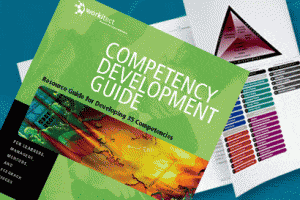 From Workitect’s Competency Development Guide, a 280-page resource guide for developing thirty-five competencies. This competency is also Functional Area Competency #11 in SHRM’s Body of Competency and Knowledge.
Importance of Fostering Diversity
The lack of diversity in a workforce can have a serious and direct impact on business results. Successful organizations are able to tap into the brainpower of talented and diverse workforces in order to serve a diversity of customers. Innovative thinking and problem solving is more likely to come from teams comprised of people with different cultural and demographic backgrounds, i.e. people with different points of view. Organizations need to optimize the use of talent at all levels with behaviors that reflect that talent comes in different packages, i.e. color, sex, age, etc.
Fostering Diversity is closely related to three other competencies in Workitect’s Competency Dictionary – Global Perspective, Fostering Teamwork and Interpersonal Awareness.
Definition of Fostering Diversity:
Working effectively with all races, nationalities, cultures, disabilities, ages and sexes; Promoting equal and fair treatment and opportunity for all.
An employee demonstrating this competency:
- Proactively seeks information from others who have different personalities, backgrounds, and styles. Includes them in decision-making and problem solving
- Communicates and cooperates with others who have a diversity of cultural and demographic backgrounds
- Makes it easy for others to feel valuable regardless of diversity in personality, culture, or background
- Includes in conversations people with diverse cultural backgrounds, and invites them to be part of informal work-related activities, such as going to lunch or attending company social events
- For a manager or team leader, hires and develops people with a diversity of cultural and demographic backgrounds.
- For an employee, helps recruit and orient employees with a diversity of cultural and demographic backgrounds.
General Considerations in Developing this Competency
Learning to value the diversity of people requires that you first understand your own values and beliefs. Those beliefs contribute to making you who you are and contribute to your worldview. It is important to recognize that other people may not agree with your beliefs or understand them. One of the best ways to learn about the value of diversity, and to foster it, is to work on a team of members with diverse backgrounds. Push yourself beyond your current environment and interactions to develop sensitivity to issues of diversity, contributing to a less ethnocentric self. Doing so can help you more fully understand, appreciate, and maximize the talents of others.

Both managers and non-managers are able to develop and demonstrate ‘fostering diversity’. Executives and managers, however, have the ability to make a greater impact, by ‘managing diversity’ – through staffing decisions and personal behaviors that motivate others to value and foster diversity.
Practicing this Competency
- Learn more about your own cultural values and background to gain a better appreciation for how they may impact your decision-making style, values, and reactions to different views.
- Actively solicit input from a wide variety of people and functions. Learn about the backgrounds, experiences and education of team members.
- Draw together diverse groups when discussing issues, solving problems, and developing opportunities. Look at issues and opportunities from other people’s viewpoints before making a decision.
- Slow down or use easier vocabulary when communicating with nonnative speakers so they can more easily follow and offer their own thoughts.
- When asking someone to explain a point of view different from your own, be sure to say that your intention is to understand the person’s viewpoint, not to have him or her justify it.
- Seek to understand diversity from a global, not just a national, perspective, if appropriate to your business and location.
- Remember that some people want their national, philosophical, or other differences to be recognized openly, while others do not.
- Partner with an individual whose background and experiences are different from your own and contract to both learn and teach one or two skills that will improve your performance in some way.
- Build a support network with colleagues who are interested in more effectively leveraging diversity. Explore ideas with each other and implement them.
- Learn more about other cultures and their values through travel, books, films, and conversations with those who have experienced other cultures, and by attending local cultural events and celebrations.
_______________________________________________________________________________________
INTERVIEWING FOR FOSTERING DIVERSITY
Competency-Based Interviewing and Selection Increases Diversity
The key to improving diversity and inclusion is to focus more on competencies than on credentials.
Use this competency-based question bank of 35 Competency Interview Guides.

_______________________________________________________________________________________
Obtaining Feedback
Ask subordinates, colleagues and your coach to describe their perception of the degree to which they see you “fostering diversity”. What are you doing that is positive and what are you doing that is not positive, or may in fact be sending the wrong signal? Ask for ongoing feedback and help. Also, how can you accelerate your fostering of diversity in your workplace? How can you all, as a group, do more to create a more diverse team?
Learning from Experts
Ask people from a variety of backgrounds for help in understanding their experiences, perspectives, and culture. Try to understand the individual as a person, and not just as a representative of a particular group. Looking at the person either as an individual only or as a representative of a group usually leads to wrong assumptions.
Establish relationships with people who are different from you. Although it is a natural tendency for people to surround themselves with others similar to them, connecting with people of different backgrounds will help you learn about the unique perspectives and contributions others have to offer.
Many large organizations have a diversity officer, usually in the human resources department. Meet with that person and ask for their advice. Interview managers and executives who have created diverse, successful teams. Observe what they do and determine how they achieved success.
Coaching Suggestions for Managers
If you are coaching someone who is trying to develop this competency, you can:
- Model the “fostering of diversity” in everything you say and do. Adopt a learner, versus judger, mindset. Utilize the differences in team members to accomplish organizational goals, and challenge assumptions and practices that limit opportunities.
- Encourage the person to push beyond their current environment and interactions to develop their knowledge of, and sensitivity to, issues of diversity. Doing so can help the person more fully understand, appreciate, and maximize the talents of others.
- Encourage participation in company or community programs that focus on learning about and valuing different cultures, races, religions and ethnic backgrounds.
- Observe the assumptions the person appears to make about people and ideas. Such assumptions may be based on both external, easily identifiable differences, as well as on more subtle, invisible differences. Share your observations.
Sample Development Goals
By February 1, I will partner with an individual whose background and experiences are different than my own and contract to both learn and/or teach several skills that will improve my performance in some way.
By October 1, I will interview Dave Murphy about the things he has done to build a successful, diverse team.
By March 1, I will fill at least one of our three openings with an individual who will expand the diversity of our team.
By May 1, I will create a support network with colleagues who are interested in more effectively leveraging diversity. At least two ideas will be explored and implemented by July 1.
At the next staff meeting on October 15, I will ask for everyone’s ideas on increasing and leveraging diversity within our group.
Resources for Developing this Competency are listed in the Fostering Diversity page of the Competency Development Guide.
Let Us Help You
Organizations can provide every employee with the content of the Competency Development Guide, and customize it to their needs, through the purchase of an intellectual property license.
Workitect is a leading provider of competency-based talent development systems, tools and programs. We use “job competency assessment” to identify the characteristics of superior performers in key jobs in an organization. These characteristics, or competencies, become “blueprints” for outstanding job performance. Competencies include personal characteristics, motives, knowledge, and behavioral skills. Job competency models are the foundation of an integrated talent management system that includes selection, performance management, succession planning, and leadership development. Contact our experienced consultants to learn how we can improve all areas of your talent management processes.
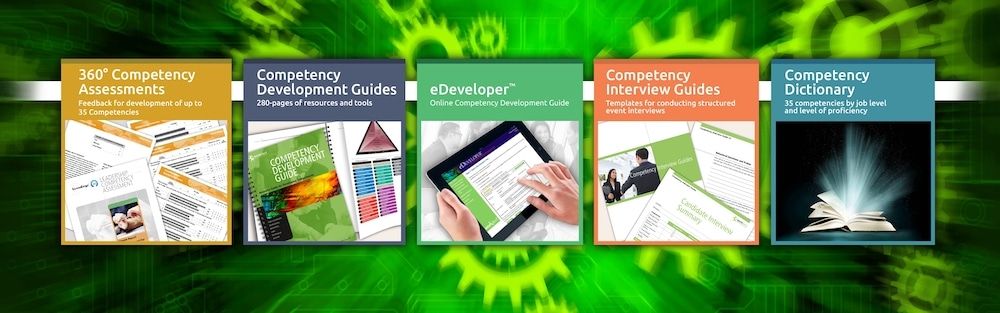
SET OF COMPETENCY-BASED TALENT MANAGEMENT TOOLS
Select and develop inclusive leaders with these practical, flexible, and cost-effective tools. One-time license fee. Competency Development Guide , eDeveloper™, and Competency Interview Guides also available for single copy purchase.
 To learn more about our products and services, and how competencies and competency models can help your organization, call 877 430 5426, email edward.cripe@workitect.com
or use the contact form at Workitect.
©️2023, Workitect, Inc.


Tags: Career Development, competency, competency dictionary, Development, leadership assessment development, Leadership Competencies, SHRM Competencies
Related Posts
Recent Posts

In Good Times & Tough Times, You Need Competent People
People. Not money, not buildings, not tools. Competent people are your most valuable resource. And…

What is the One-Size-Fits-All Competency Model?
In the One-Size-Fits-All Approach, a competency model is developed for a broadly defined set of…

Is Your Performance Management System Working?
If it isn’t working, consider a… COMPETENCY-BASED PERFORMANCE MANAGEMENT SYSTEM Many organizations are becoming…

The New Reality: Career Streams vs. Career Ladders
Along with many other changes in how employee performance is managed, there is a…