
Include Competencies in Your HRIS or HCM Software
[fusion_builder_container hundred_percent=”no” equal_height_columns=”no” hide_on_mobile=”small-visibility,medium-visibility,large-visibility” background_position=”center center” background_repeat=”no-repeat” fade=”no” background_parallax=”none” parallax_speed=”0.3″ video_aspect_ratio=”16:9″ video_loop=”yes” video_mute=”yes” border_style=”solid” flex_column_spacing=”0px” type=”legacy”][fusion_builder_row][fusion_builder_column type=”1_1″ layout=”1_1″ background_position=”left top” border_style=”solid” border_position=”all” spacing=”yes” background_repeat=”no-repeat” margin_top=”0px” margin_bottom=”0px” animation_speed=”0.3″ animation_direction=”left” hide_on_mobile=”small-visibility,medium-visibility,large-visibility” center_content=”no” last=”true” hover_type=”none” first=”true” min_height=”” link=”” background_blend_mode=”overlay”][fusion_text columns=”” column_min_width=”” column_spacing=”” rule_style=”” rule_size=”” rule_color=”” hue=”” saturation=”” lightness=”” alpha=”” content_alignment_medium=”” content_alignment_small=”” content_alignment=”” hide_on_mobile=”small-visibility,medium-visibility,large-visibility” sticky_display=”normal,sticky” class=”” id=”” margin_top=”” margin_right=”” margin_bottom=”” margin_left=”” fusion_font_family_text_font=”” fusion_font_variant_text_font=”” font_size=”” line_height=”” letter_spacing=”” text_transform=”” text_color=”” animation_type=”” animation_direction=”left” animation_speed=”0.3″ animation_offset=””]
Using Competencies to Develop A Practical “Theory” of
HOW TO DEVELOP A “TAILORED” MODEL
When a company considers or purchases human resource information system software, the software usually comes with a pre-loaded list of competencies that are integrated into the HR applications in the system. The competencies that are selected for inclusion in the system usually come from several different sources:
- Off-the-shelf competency models or pseudo models, such as job descriptions (mistaken for competency models), for job categories. For example, there are many different existing profiles or models of a generic manager job or sales representative job.
- Competency dictionaries or libraries compiled by an HRIS company’s staff from existing lists of competencies, usually based on the experience of a consulting firm, writer, or academic institution.
- Surveys and brainstorming sessions within a company, tabulating opinions about competencies required within the organization for effective or superior performance.
The problem with using these sources is that the competencies and models are:
- Not created with a proven research-based methodology
- Not tailored to the organization
As a result, the applications may include competencies that will not lead to effective or superior performance. In fact, selecting and developing the wrong competencies may lead to failed performance.
The rationale for developing competency models customized to the organization is further explained in “Doing Competencies Well: 20 Best Practices in Competency Modeling”.* The 17th best practice is:
Using Competencies to Develop A Practical “Theory” of
Effective Job Performance Tailored to the Organization
Competency models explain the nature of effective performance in an organization. They describe what really matters in terms of job performance and how to be successful. In this way, they are not only much more than lists of KSAOs (Knowledge, Skills, Abilities, Other Characteristics) or job descriptions that result from job analysis, but instead are more of a theory in the following ways (Whetten, 1989):
- They explain why the KSAOs matter in terms of creating effective job performance, connecting with organizational goals, and so on.
- They usually include a description of the process (how effective performance occurs) as well as the content (what is effective performance).
- They are internally consistent in that performance on one competency should not conflict with performance on another competency. They should reinforce each other in clear ways.
- They predict and explain successful performance in a wide range (hopefully all) of job domains.
- They may inform judgments with respect to likely outcomes (e.g., who will get hired, promoted, or rewarded).
- They are provocative and promote thought and discussion about effective job performance. As such, they should yield more insight than a list of KSAOs.
HOW TO DEVELOP A “TAILORED” MODEL
- Identify the Superior Performers
In specific job or role, based on:
Performance measurements/results
Ratings by supervisors, subordinates, peers, and/or customers - Collect Data
Behavioral Event Interviews
Resource/Expert Panels
Expert system data base - Create Model
Identify Job Tasks & Job Competency Requirements, “Competency Model”
Read more in this blog post: “Tailor job competency models to your organization’s vision, mission, and shared values”
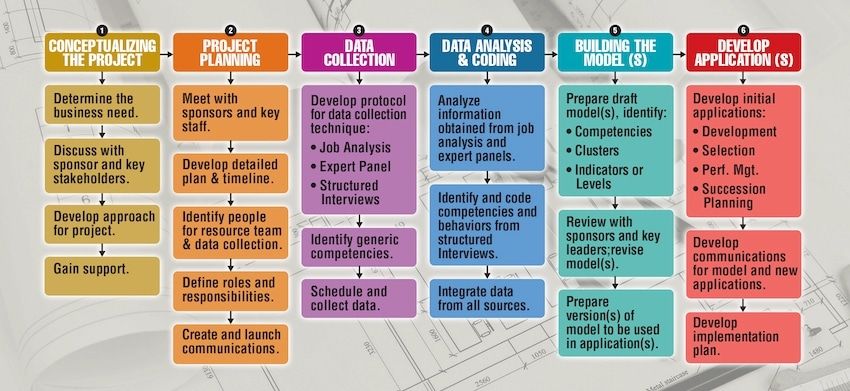
The complete six-step process that is used in our model-building work and taught in our Building Competency Models workshop is shown below.
THE RIGHT COMPETENCIES TO INCLUDE IN A HRIS
Include competencies that have been identified, through an objective model building methodology, to be possessed by the effective and superior performers in your unique organization. Review the competencies that are already included in the HRIS software. If they don’t match up with the ones that are included in your competency models, ask that they be included. The competencies may be contained in a competency dictionary that you used to build the models.
 For additional information, call 800-870-9490, email edward.cripe@workitect.com
or use the contact form at Workitect.
©️2025, Workitect, Inc.
[/fusion_text][/fusion_builder_column][/fusion_builder_row][/fusion_builder_container]
Related Posts
Recent Posts

In Good Times & Tough Times, You Need Competent People
People. Not money, not buildings, not tools. Competent people are your most valuable resource. And…

What is the One-Size-Fits-All Competency Model?
In the One-Size-Fits-All Approach, a competency model is developed for a broadly defined set of…
Is Your Performance Management System Working?
If it isn’t working, consider a… COMPETENCY-BASED PERFORMANCE MANAGEMENT SYSTEM Many organizations are becoming…

The New Reality: Career Streams vs. Career Ladders
Along with many other changes in how employee performance is managed, there is a…