The Right Way to Plan a Competency Modeling Project
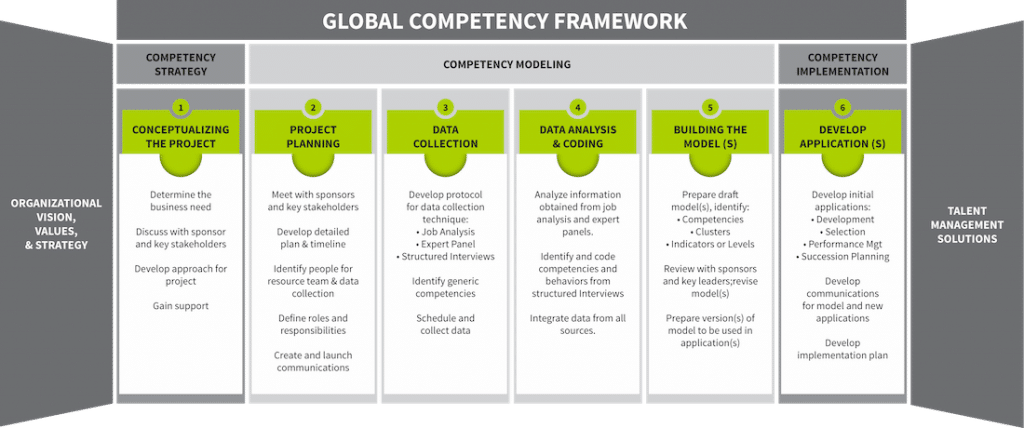 Project Planning is Step 2 of Workitect’s process for building a job competency models.
The key steps in planning a project to develop competency models and competency-base applications are:
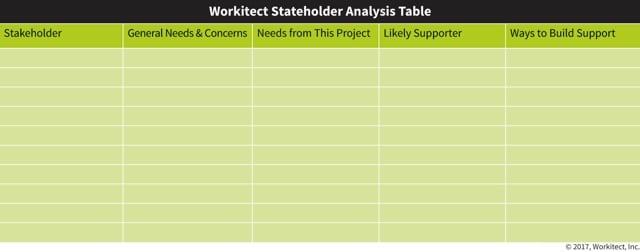
- Conducting a stakeholder analysis, identifying the people in the organization who have the most at stake in the development and implementation of competency models, and determining how and when they should be involved.
- Preparing a draft project plan
- Holding initial project planning meeting with project team to:
- Review and revise draft project plan
- Develop detailed plan with timeline and assigned responsibilities
- Identify and agree on participants needed for each data collection activity
- Creating and implementing a communication plan for people directly involved in the project and for all employees.
WORKSHEET FOR PLANNING A COMPETENCY MODELING PROJECT
This is a helpful checklist of key questions and issues related to the key steps that need to be addressed when launching a model-building project. It includes these sections.
- Scope of the Project
- Organizational Context
- Selecting the Approach to Model Building
- Building Support for the Project
- Deciding on Data Sources
- Staffing the Model Building Project
- Envisioning the Data Analysis and Model Building
- Reviewing and Revising the Model
In working through this worksheet, you may find that some questions are difficult to answer without a better understanding of areas such as the methodology for data gathering, data analysis and model building, and developing HR applications based on competency models. This information is covered in steps 3-6 of the six-step process that is used in our consulting practice and taught in our Building Competency Models workshop. It can also be found in the Resources & Support section of the Workitect website. Additional self-instruction material is included in Workitect’s quick start Building a Basic Model program that is available to licensees of the Workitect Competency Dictionary.
_____________________________________________________________________________
Possible ways to address several of these questions and issues are described below:
STAKEHOLDER ANALYSIS
After conceptualizing an approach to the project, a good first step in planning to think systematically about the stakeholders who will be affected by the competency-modeling project that you are considering. Possible stakeholders include:
- Job incumbents in the jobs for which competency models will be built
- Managers of job incumbents
- Upper management (two or more levels above the job holders)
- HR leaders who work with job incumbents or their managers
- Internal or external consultants who work with job incumbents or their managers
- The senior leader of HR
- Internal customers of job incumbents
- Informal leaders who can influence any of the above groups
In thinking about stakeholders, try to answer these questions:
- Apart from this project, what are the most important needs, agendas and concerns of this individual or group?
- How can you learn more about the most important needs, agendas or concerns of this individual or group?
- How can this project address a need, agenda, or concern of this individual or group?
- What will be the likely response of this individual or group to the project you are contemplating: support, resistance, or neutrality?
- For each stakeholder, what can you do to build support or reduce resistance?
STRUCTURE OF THE PROJECT PLAN
After conceptualizing an approach to the project, the next step is to develop a project plan, which should include a set of tasks and a timeline. The format of the finished plan might have the following structure.
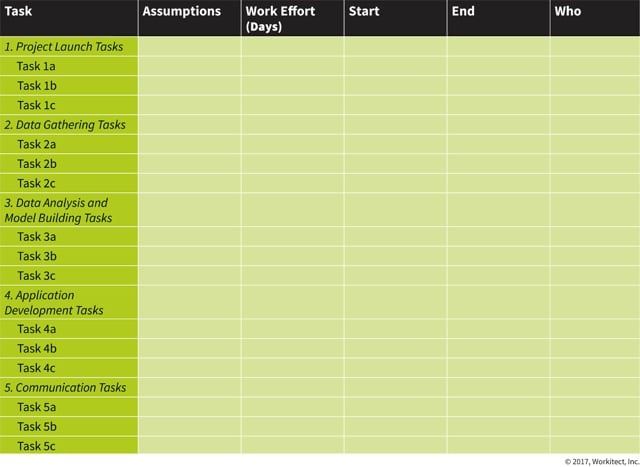
The project tasks are broken down into five groups. Project Launch activities might include:
- a meeting with the project sponsor(s)
- a meeting of project team to review and refine the project plan
- training or preparing project team members to conduct interviews, resource panels and focus groups and to perform individual data analysis tasks
Data Gathering activities include:
- Gathering and reviewing company documents relevant to the project, (e.g., existing job descriptions, organization charts, mission and values statements, performance appraisal forms, the organization’s strategic plan)
- Identifying participants for each of the main data gathering activities (e.g., interviews, resource panel, focus groups)
- Developing protocols for each data gathering activity (e.g., interview guide, questions to pose to resource panel and focus groups
- Conducting each data gathering activity
Data Analysis and Model Building activities include:
- Transcribing interviewers’ notes or tapes and notes on flip charts from resource panels and focus group
- Individually analyzing interview notes or transcripts from each data gathering
- Meeting to review and compare the results of individual
- Preparing a draft competency model
- Reviewing and revising the draft competency model based on feedback from the sponsor and other stakeholders
Application Development activities include:
- Designing the application
- Developing the tools and materials to support the application
- Preparing a training or educational session on use of the application
- Implementing the application
Communications activities include:
- Preparing a draft email message to be sent by the organization’s senior leader explaining the purpose and benefits of the project to job incumbents and managers of job incumbents in jobs for which competency models will be built
- Meetings with managers of job incumbents to explain the project
- Preparing communications inviting participation from individuals selected for data gathering activities
- Regular meetings with the project sponsor(s) to provide updates on project activities
- Preparing periodic email communications to key stakeholders regarding progress with the project
- Developing a presentation of the competency model(s) and application
- Delivering the presentation to key stakeholder groups, such as upper management, managers of the job incumbents, and the job incumbents
COMMUNICATING WITH STAKEHOLDERS AND EMPLOYEES
When launching and implementing a competency-modeling project, the leaders of the project have to clearly and comprehensively communicate with two audiences:
1. All employees, and
2. The managers and employees who will be directly involved in the project
ALL EMPLOYEES
When any new project is undertaken within an organization, particularly one initiated by the human resources department, people have a natural tendency to get suspicious, concerned, or just curious. Employees who understand the project, it’s scope, each person’s involvement in it, and it’s potential benefits will help turn suspicion into support, and will go a long way toward making the project successful.
If your organization has access to an internal or external employee communications expert, use that expertise to help you plan and implement an effective communications effort.
Here a few points that can be covered in communicating the project. Ideally, the initial announcement should come from the senior sponsor and include:
- The business need for creating this model at this time.
- The name of the senior sponsor for the project.
- Names of people on the project team.
- How will the model be used, the application, and when will it be implemented.
- Who is involved in creating the model- particularly jobholders and managers of job-holders.
- Who to contact with questions
PEOPLE DIRECTLY INVOLVED
In addition to receiving the same communications provided to all employees, the people involved in various aspects of the project should receive clear and complete information about their specific role.
When informing people who will be on a resource panel or will be interviewed:
- The communications can be from senior sponsor or a senior person on project team.
- Reiterate purpose for the project.
- Explain why they were selected.
- Explain how they are to participate, either on the panel or in an interview.
- Attach key questions they will be asked (for them to consider before their session).
- Stress that their individual comments will be held confidential; only a summary of all comments will be published.
- Inform them of the person they can contact with questions.
When distributing the model or application:
- Communications should be from senior sponsor.
- Summarize the history of the project to this point.
- List the people who participated in creating the model/application.
- Explain the implementation plan and timeline.
- Inform them of the person they can contact with questions.
In summary, do not underestimate the importance of this step. A competency-based human resource system, implemented properly, should have a very positive impact on employees’ job satisfaction. It makes it more likely that people will be assessed fairly and accurately, and be afforded opportunities based on objective criteria (a picture of what superior performers really do that makes them superior performers). Poor communications of a model-building project leads to a diminishing of this positive effect and can actually lead to a negative result.
Practical Questions for HR Professionals Who are Building Competency Models
When planning the development of a competency model or models, there are practical
considerations that affect the design of the project, the format and content of the competency model, and the success of the project’s implementation. The following seven questions may be useful to Human Resouces professionals responsible for planning and implementation:
1. What HR application should be included in the initial model building project?
2. What will the key users of the model need from it?
3. How should key stakeholders be involved?
4. How extensive should the data collection be?
5. How should research be balanced with intuitive approaches?
6. What format of behavioral descriptors will best suit the application?
7. How can additional, future competency models be accommodated?
 For additional information, call 800-870-9490, email edward.cripe@workitect.com
or use the contact form at Workitect.
©2019, Workitect, Inc.

Tags: business strategy, competency models, competency system, framework, HR strategy, modeling, performance, strategy
Related Posts
Recent Posts

In Good Times & Tough Times, You Need Competent People
People. Not money, not buildings, not tools. Competent people are your most valuable resource. And…

What is the One-Size-Fits-All Competency Model?
In the One-Size-Fits-All Approach, a competency model is developed for a broadly defined set of…
Is Your Performance Management System Working?
If it isn’t working, consider a… COMPETENCY-BASED PERFORMANCE MANAGEMENT SYSTEM Many organizations are becoming…

The New Reality: Career Streams vs. Career Ladders
Along with many other changes in how employee performance is managed, there is a…