
How you can benefit from having a competency model for your job.

A COMPETENCY MODEL FOR YOUR JOB CAN PROVIDE THESE BENEFITS FOR YOU IN YOUR ORGANIZATION
A. Clear Job Requirements:
What do you need to do to be successful at work?
Competencies define the skills needed for your current or desired job, creating alignment around expectations at work. You can use them to assess your own skills, increase your self-awareness, and identify how to improve your performance in your current job or your candidacy for another job.
B. Objective Performance Reviews:
Do you have a clearly defined process to track skill progression?
Competencies, and the associated behavioral indicators, add objectivity to the performance management process by defining what and how well you are performing certain skills. It is not based on your manager’s subjective conclusions about your performance and competencies. You can track your own performance and document how well you performed against a specific competency, revealing how well you demonstrated the desired behavioral indicators.
C. Evaluation of Career Potential:
Do you know how to gain career mobility at your organization?
Your potential for other positions in your organization has probably already been evaluated, based on the skills, knowledge, and “intangibles” you are perceived to possess. Wouldn’t you like transparency, to know what those intangibles are, so that you can reset your career aspirations or develop the competencies you need in order to advance? In comparing people’s performance and potential, a competency model provides a consistent, objective and valid framework for the evaluation. If none exists, you don’t know what is being used as a measuring stick, e.g. loyalty to boss, tenure, etc.
D. Clear and Concise Feedback:
Is there a common language to communicate development opportunities?
Competencies allow people to give you clearer, more concise and understandable feedback about your strengths and development opportunities. They also offer a common language to give and receive feedback, used to set goals. Would you prefer to hear “you need to work on your selling skills” or “you would be more effective in selling your ideas if you more actively sought to understand others’ needs and concerns before trying to promote your ideas”.
E. Achievable Development Plans:
Do you have a realistic, behavioral specific plan for success?
A competency model helps you to build your development plan by pointing to specific behaviors in which you are successful and where you should improve. You can then benchmark progress and create future action plans, leveraging your strengths to address developmental needs. In the previous example, the focus for development would be to “better identify others’ needs and how your ideas will assist them”. This is a better and more achievable development objective than to simply “improve your influencing skills”.
Download Workitect’s free Career Planning Kit
DEVELOPING COMPETENCY GOALS
A process for developing competency goals is described below. While you may begin this process at the development planning meeting with your manager, afterwards you will need to do some additional individual planning and follow-up with your manager.
For each competency you have targeted for development:
1. Read the section on this competency, in Part II “Specific Suggestions for Developing Each Competency.” of Workitect’s Competency Development Guide.
2. Prepare a list of 6-15 goals you would like to include in your development plan for this competency. Each goal should specify some specific activity that you will complete by a specific date. Sample competency development goals are provided for each competency.
3. Draw on, but do not necessarily limit yourself to, the specific suggestions provided for developing this competency.
4. Include some goals that involve practicing the behaviors of the competency in relatively safe situations, where mistakes will not have significant consequences.
5. Include some goals that involve practicing the behaviors of the competency in situations that will help you achieve your job or business goals.
6. Create a list of goals for this competency that is both realistic and challenging. Assume that you will focus your developments on one competency for a 3-4 month period and that you will spend 3-6 hours per week, in addition to your regular job responsibilities, working on your competency goals.
7. Review a draft list of your goals for this competency with your manager and get his/her input.
8. Enter the competency development goals on a copy of the Competency Development Planning Form.
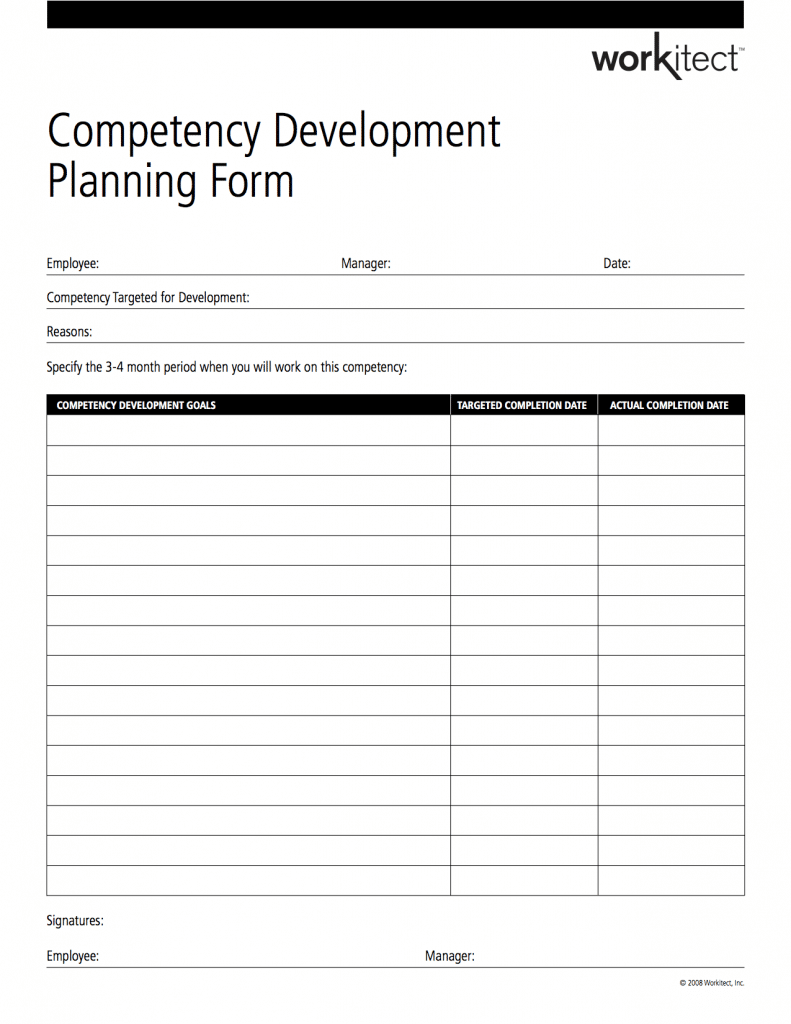 9. Repeat this process for the two other competencies you have targeted for development.
More information and tips can be found in our Competency Development Guide or free Career Planning Kit.
Discussion Question: If you now have a competency model for your position, what has it meant for you personally? Positive, negative, or no effect?
 To learn more about our products and services, and how competencies and competency models can help your organization, call 800-870-9490, email edward.cripe@workitect.com
or use the contact form at Workitect.
©️2024, Workitect, Inc.
Tags: Career Development, Career Planning, competency models, leadership assessment development, Leadership Competencies, performance, talent
Related Posts


Recent Posts

In Good Times & Tough Times, You Need Competent People
People. Not money, not buildings, not tools. Competent people are your most valuable resource. And…

What is the One-Size-Fits-All Competency Model?
In the One-Size-Fits-All Approach, a competency model is developed for a broadly defined set of…
Is Your Performance Management System Working?
If it isn’t working, consider a… COMPETENCY-BASED PERFORMANCE MANAGEMENT SYSTEM Many organizations are becoming…

The New Reality: Career Streams vs. Career Ladders
Along with many other changes in how employee performance is managed, there is a…