

Competencies and Competitiveness
[fusion_builder_container hundred_percent=”no” equal_height_columns=”no” hide_on_mobile=”small-visibility,medium-visibility,large-visibility” background_position=”center center” background_repeat=”no-repeat” fade=”no” background_parallax=”none” parallax_speed=”0.3″ video_aspect_ratio=”16:9″ video_loop=”yes” video_mute=”yes” border_style=”solid” flex_column_spacing=”0px” type=”legacy”][fusion_builder_row][fusion_builder_column type=”1_1″ layout=”1_1″ background_position=”left top” background_color=”” border_color=”” border_style=”solid” border_position=”all” spacing=”yes” background_image=”” background_repeat=”no-repeat” padding_top=”” padding_right=”” padding_bottom=”” padding_left=”” margin_top=”0px” margin_bottom=”0px” class=”” id=”” animation_type=”” animation_speed=”0.3″ animation_direction=”left” hide_on_mobile=”small-visibility,medium-visibility,large-visibility” center_content=”no” last=”true” min_height=”” hover_type=”none” link=”” first=”true” type=”1_1″][fusion_text]
[/fusion_text][/fusion_builder_column][/fusion_builder_row][/fusion_builder_container]
 RAISE THE BAR ON EMPLOYEE PERFORMANCE
Several years ago, the WorldAtWork association sponsored a research study titled “Raising the Bar – Using Competencies to Enhance Employee Performance”. The results were published in a 76-page booklet. The findings are still relevant and insightful today.
The research demonstrated that competencies connect with business strategy, and that organizations use a variety of techniques to build competency models. While competency-based talent management applications are not new, for many organizations competencies have yet to fulfill their potential as a means to improve employee performance and, ultimately, enhance business results. But attitudes toward competencies are largely positive, and a large majority of organizations want to expand the role of competencies within their organizations.
Following are the key findings of the original research effort. Based on our own research and experience in the field, most are still valid in 2020.
• Competencies are used to “raise the bar” on employee performance.
HR executives say “raising the bar” is a key objective of competencies, as opposed to using competencies to establish a baseline for performance. Also, many HR executives tailor their HR applications to focus on individual performance. Competencies are defined thoroughly (often using high performers and functional experts as a primary source of input), and they often are supported with scaled levels to illustrate increasing levels of proficiency. This provides individuals with detailed road maps for increasing their capabilities incrementally.
For staffing applications, competencies are used to hire, place and promote people with the right capabilities to help the organization gain competitive advantage. For training and development, competencies are used to identify gaps in each participating employee’s capabilities so these gaps can be remedied. For performance management, competencies and results are assessed side by side, reminding employees that how they do things is as important as what they do. For compensation, both competencies and results impact base pay decisions to reward performance and competency development.
• Competencies are used to focus on an organization’s culture and values.
Many organizations use competency-based applications to communicate values to the work force and to build the proper culture for success. While these issues may appear somewhat removed from the bottom line, many organizations recognize the importance of culture in achieving competitive advantage.
• Business strategies drive competencies.
Competency information comes from multiple sources, and strategy plays a key role in development. The most frequent source of information is senior management and strategic plans. The next most common sources of information are high performers and functional experts. These sources of information often are used in combination.
• Competencies focus on how performance results are achieved.
Competencies are behavioral models that are built upon skills, knowledge and personal attributes. Furthermore, all attributes of competencies should be observable and measurable, and they must contribute to enhanced employee performance and, in turn, organizational success.
• Competency applications are evolutionary, not revolutionary.
First, it appears that many competency-based approaches are treated as add-ons and are not leading to radical adjustments in HR processes. Second, with regard to specific HR applications, many managers continue to make the lion’s share of performance management and compensation decisions. Furthermore, with the exception of the use of behaviorally anchored rating scales, base salary adjustments under competency-based systems are largely made in a traditional fashion. Finally, for staffing purposes, competencies are rarely used when checking references or as the sole basis for rejecting candidates.
• Competencies provide a framework for integrating HR applications.
Integrating HR applications is a desired outcome for most organizations. Many HR functions have more than one competency-based HR application. Those who have applications in place for more than a year usually desire to expand competencies into additional HR areas. Lessons learned in one area of competency-based HR should be applied to other competency applications.
• Compensation is the least common application.
Performance management is the most cited application, and staffing and training and development are in between. Staffing applications tend to be oldest, followed by performance management, training and development, and compensation applications. This may imply that staffing applications represent starting points for many organizations that are interested in competencies. Compensation is seen as an application that can be added once other applications are in place. One reason for why staffing applications are older may be historical; David McClelland and McBer’s early work with competencies was to examine them for selection purposes.
These findings should not be interpreted as a prescription for the order in which to install competencies. Many organizations start competencies in different areas of HR and then gradually work their way to other areas. In fact, many organizations also work on more than one application at once. The key is not the order in which applications are developed, but how these applications ultimately are integrated and linked to business strategy.
Read the original report, pages 1-35, pages 36-72.
Additional findings and other relevant studies will be published in future blogs.
Read more…….to learn more about the benefits, and how to create an integrated HR system, download Competencies & Competitiveness.
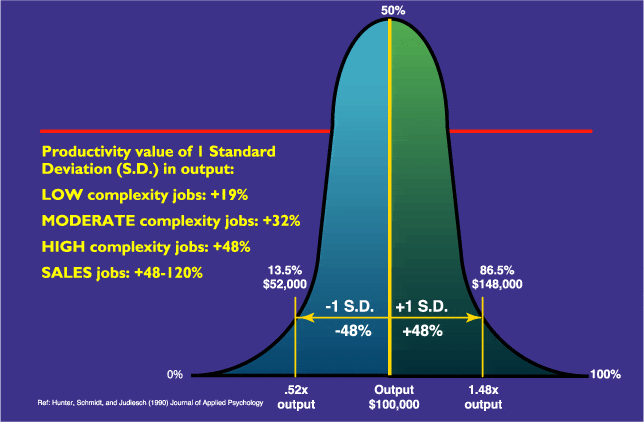
Also in “The ROI of Competency Technology” – What is superior performance worth in your organization?
“Workitect’s competency modeling process gave us a solid foundation to select and develop high performing branch managers and customer service reps. Their consultants worked well with all levels – from executive to front-line employees. They were professional, easy to work with, and good at sharing their expertise and organizational insight with us.” Director, Organizational Learning

To learn more about our products and services, and how competencies and competency models can help your organization, call 800-870-9490, email edward.cripe@workitect.com
or use the contact form at Workitect.
©️2020, Workitect, Inc.

Tags: business strategy, change management, competencies, competency models, HR strategy, productivity, strategy, talent strategies
Related Posts
Recent Posts

In Good Times & Tough Times, You Need Competent People
People. Not money, not buildings, not tools. Competent people are your most valuable resource. And…

What is the One-Size-Fits-All Competency Model?
In the One-Size-Fits-All Approach, a competency model is developed for a broadly defined set of…
Is Your Performance Management System Working?
If it isn’t working, consider a… COMPETENCY-BASED PERFORMANCE MANAGEMENT SYSTEM Many organizations are becoming…

The New Reality: Career Streams vs. Career Ladders
Along with many other changes in how employee performance is managed, there is a…