
Criteria for an Effective Competency Model
 In our consulting practice, I speak with many HR executives who tell me about the competency models they have developed in their organization and about the impact those models have had on their HR practices and the organization as a whole. Many say that they have already created competency models that they are either happy with or want to improve. And some want to trash what they have done and start over, or build models for the first time.
POPULAR MODEL-BUILDING PRACTICES
For those who have already created models, when asked to describe the process they used, many HR professionals say that the models were created by:
- Interviewing the CEO, other executives, incumbents of the position being modeled and their managers and asking for their opinion as to the competencies required by employees to carry out the organization’s strategic plan. The focus of the model is often on managers in the organization, and may be referred to as the leadership model.
- Collecting the same or similar information in a meeting or series of meetings or focus groups.
- Other means, such as card-sorting, surveys, computer selection, off-the shelf models, adaptations of job descriptions, self assessments by employees, etc.
- A combination of the above.
Models created using these methods often achieve their intended purpose. Competencies are incorporated into performance management, selection, training, and other HR applications. But, they are “basic” models. They, and the applications that are developed, are based on the opinions of various people about competencies required for specific jobs. They are not determined using a validated, research-based analysis of superior performers. There is a better way, a way that produces a far greater ROI for a model-building project
AN EFFECTIVE COMPETENCY MODEL – UNBIASED & ACCURATE
I believe that the best methodology for building job competency models is Job Competence Assessment (JCA), developed in the 1970’s by Dr. David McClelland, a pioneer in motivation and competency research and testing at Harvard, and by consultants at McBer and Company.
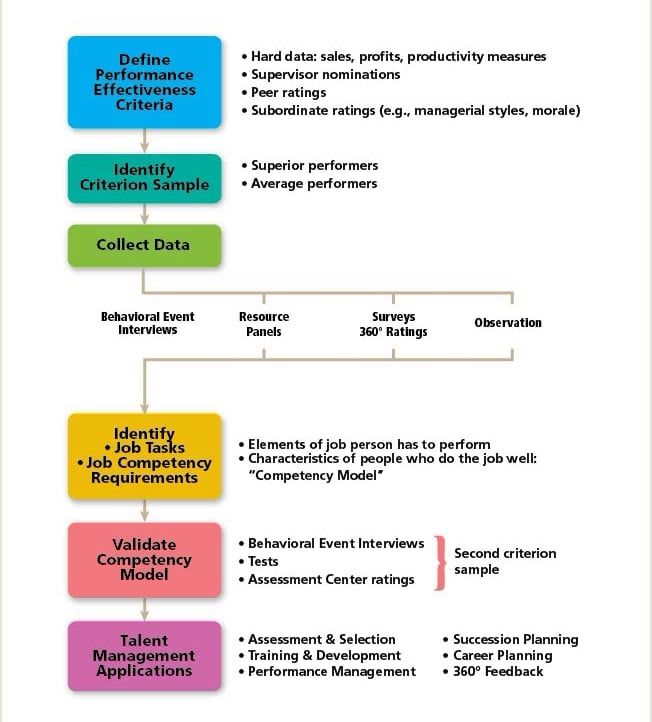
The modeling process starts with superior performers in a targeted job being identified, and then studied to identify the personal characteristics, skills, and knowledge that they possess that enables them to be superior performers. The methods used to collect data for the study, such as behavioral event interviews and expert panels, are designed to get beneath mere opinions about superior performance and superior performers. Since each organization has its own culture, mission, and ways of doing business, performance in one organization may require competencies that are different than those required in another organization. This is the reason that off-the-shelf models may not be useful.
These are the phases of this model-building methodology:
We have covered several of these specific steps in previous blogs and will examine additional ones in future blogs. A detailed description of the JCA methodology is provided in Competence At Work, a book by Spencer & Spencer and on pages 5-7 of Integrating Key Human Resource Processes, a 10-page booklet that describes competencies and how to create an integrated human resource system with applications for selection, succession planning, career pathing, performance management, and training.
In summary, JCA is an accurate, unbiased approach to predicting job performance and success. It is characterized by its rigorousness and yet its accessibility to managers and HR professionals with little or no background in statistics and competency research, the JCA methodology enables you to match the right people to the right jobs.
___________________________________________________________________
REVIEW OF THE BASICS
What is a Competency?
A competency is an underlying characteristic of an individual, which can be shown to predict Superior or Effective performance in a job; and indicates a way of behaving or thinking, generalizing across situations, and enduring for a reasonably long period of time.
What is a Competency Model?
A model is a group of related competencies that together describe superior or effective performance for a particular job or role, in a particular organization. Examples:
Account Representative (Distribution company)
Executives (Manufacturing company)
Marketing Representative (Insurance company)
Project Manager (High Tech)
___________________________________________________________________
DISCUSSION QUESTION
What methodology have you used to build models and applications and how would you rate its effectiveness? What did you learn and what might you do differently next time?
_________________________________________________________________________
An adaptation of the JCA methodology is used in Workitect’s consulting practice and is taught in our Building Competency Models workshop. It is also influences the content of our products, including the Competency Development Guide, Competency Interview Guides, and Competency Dictionary.
 For additional information, call 800-870-9490, email edward.cripe@workitect.com
or use the contact form at Workitect.
©2019, Workitect, Inc.

Tags: competency assessment, competency modeling, competency models, competency system, integrated hr applications, job competencies, McBer, talent management
Related Posts
Recent Posts

In Good Times & Tough Times, You Need Competent People
People. Not money, not buildings, not tools. Competent people are your most valuable resource. And…

What is the One-Size-Fits-All Competency Model?
In the One-Size-Fits-All Approach, a competency model is developed for a broadly defined set of…
Is Your Performance Management System Working?
If it isn’t working, consider a… COMPETENCY-BASED PERFORMANCE MANAGEMENT SYSTEM Many organizations are becoming…

The New Reality: Career Streams vs. Career Ladders
Along with many other changes in how employee performance is managed, there is a…