
How to Develop the Competency of Decisiveness
Leaders, especially those in senior management, need Decisiveness. They must be able to make high stakes decisions, such as whether to accept a multi-million dollar deal, restructure the organization, cancel a venture that is not going well, shut down a plant, or eliminate a large number of jobs. Decisiveness does not mean making decisions impulsively or intuitively; it does mean willingness to step up to a decision when a decision is needed.
Definition: Willingness to make difficult decisions in a timely manner.
- Is willing to make decisions in difficult or ambiguous situations, when time is critical
- Takes charge of a group when it is necessary to facilitate change, overcome an impasse, face issues, or ensure that decisions are made
- Makes tough decisions (e.g., closing a facility, reducing staff, accepting or rejecting a high-stakes deal)
General Considerations in Developing this Competency
One of the best ways to learn this competency is to be thrust into a situation where time-critical decisions are required, and you must make the best decisions you can, under pressure. It may also help to work closely with a leader who demonstrates Decisiveness, to see first hand how this person makes decisions.
Another approach is to reflect on your own behavior. Think of situations in which you needed to make a decision. What did you do? Did you act decisively? Would you handle this situation the same way today? What would you do differently?
Practicing this Competency
- Volunteer for assignments in which you will be responsible for making decisions.
- Practice using a simple analytical process in making decisions: Answer these questions:
1) What are the criteria that should be considered in making this decision?
2) What are the alternatives?
3) For each alternative:
- What are the positive results if things go well?
- Can you quantify the benefits of a positive outcome?
- What are the possible risks? What could go wrong?
- Can you quantify the costs of a negative outcome?
- What is the probability of a positive outcome?
- Look for opportunities to take charge of a group to overcome an impasse, ensure that the group faces an issue, or change the direction in which the group is moving.
Obtaining Feedback
Ask someone to observe you over a one-month period and give you feedback regarding decisiveness. Ask this person to point out when you are demonstrating Decisiveness effectively, when you are making decisions too hastily, and when you need to be more decisive.
Learning from Experts
If you have the opportunity to work closely with a decisive leader, observe this person’s decision making behavior. How does this person make decisions?
Interview a leader who is strong in Decisiveness. Ask the person to talk about several situations in which he/she had to make a decision. Ask the person to walk you through each situation. Find out what the person did, said, and thought, in the process of making each decision. Reflect on what you have heard. What behaviors could you benefit from by adopting?
Coaching Suggestions for Managers
If you are coaching someone who is trying to develop this competency, you can:
- Give the person ongoing, constructive feedback about behavior in decision making situations.
- Empower this person to make decisions in his/her area of work.
- Provide assignments that involve decision making.
- Be supportive when a decision does not work out. Decisive people do not always make decisions that work out as planned. Rather than criticize the employee, debrief the situation with the employee to help identify what can be learned from it.
Sample Development Goals
By December 1, I will interview Mary Byrne to learn how she makes decisions.
At the next meeting of the Production Team, I will intervene quickly if the group starts to go off track. Afterwards, I will ask two team members for feedback on my behavior.
On March 1, I will review the proposals from different vendors and make a decision on
that day.
Within one week, I will confront Deborah about her performance problem and begin implementing the disciplinary process.
WHAT METHODS OR RESOURCES HAVE YOU SEEN TO BE MOST EFFECTIVE IN DEVELOPING “DECISIVENESS” IN LEADERS?
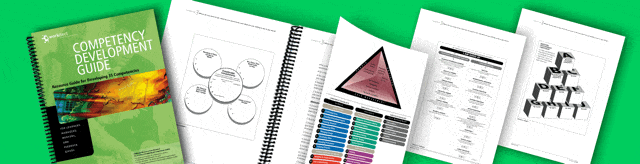
Resources for developing this competency are listed in the Competency Development Guide. Organizations can provide every employee with the content of the Competency Development Guide, and customize it to their needs, through the purchase of an intellectual property license.
Workitect is a leading provider of competency-based talent development systems, tools and programs. We use “job competency assessment” to identify the characteristics of superior performers in key jobs in an organization. These characteristics, or competencies, become “blueprints” for outstanding job performance. Competencies include personal characteristics, motives, knowledge, and behavioral skills. Job competency models are the foundation of an integrated talent management system that includes selection, performance management, succession planning, and leadership development. Contact our experienced consultants to learn how we can improve all areas of your talent management processes.
 To learn more about our products and services, and how competencies and competency models can help your organization, call 800-870-9490, email edward.cripe@workitect.com
or use the contact form at Workitect.
©️2019, Workitect, Inc.

Tags: building, business strategy, Career Development, competency, decisiveness, Development, Leadership Competencies, talent, talent strategies
Related Posts
Recent Posts

In Good Times & Tough Times, You Need Competent People
People. Not money, not buildings, not tools. Competent people are your most valuable resource. And…

What is the One-Size-Fits-All Competency Model?
In the One-Size-Fits-All Approach, a competency model is developed for a broadly defined set of…
Is Your Performance Management System Working?
If it isn’t working, consider a… COMPETENCY-BASED PERFORMANCE MANAGEMENT SYSTEM Many organizations are becoming…

The New Reality: Career Streams vs. Career Ladders
Along with many other changes in how employee performance is managed, there is a…