What is a Competency?
A competency is an underlying characteristic of an individual, which can be shown to predict Superior or Effective performance in a job; and Indicates a way of behaving or thinking, generalizing across situations, and enduring for a reasonably long period of time.
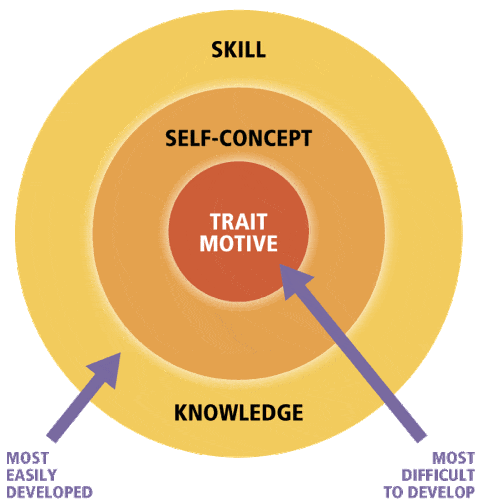
There are five types of characteristics:
- Skills: e.g., active listening
- Knowledge: e.g., electronics, conflict resolution methods
- Self-Concept (attitude or value): e.g., team vs. personal achievement, occupational preference
- Trait: e.g., stamina
- Motive: e.g., achievement motivation
Implications for talent management and development
Some types are more visible than others – like sections of an iceberg. The type of competency has practical implications for talent management and development. Knowledge and skill competencies tend to be visible, and relatively surface, characteristics of people. Self-concept, trait, and motive competencies are more hidden “deeper”, and central to a person’s personality.
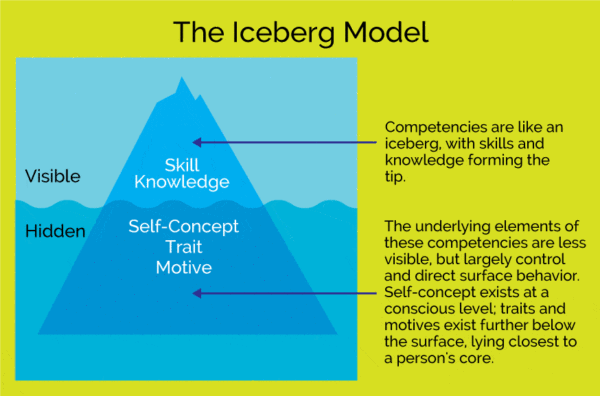
Surface knowledge and skill competencies are relatively easy to develop; training is the most cost-effective way to secure these employee abilities. “Core” motive and trait competencies are hard to assess and develop; it is most cost-effective to select for these characteristics. Self-image, self-concept competencies, such as self-confidence can be changed, albeit with more time and difficulty; these attributes are most cost effectively addressed by training, by psychological counseling, and/or with positive developmental job assignments.
An Example of a Competency
ADAPTABILITY
Definition: The ability to keep functioning effectively when under pressure and/or experiencing rapidly changing or uncertain conditions, and to maintain self-control in the face of hostility or provocation.
Observable behaviors
- Remains calm under stress
- Can effectively handle several problems or tasks at once
- Controls his/her response when criticized, attacked or provoked
- Maintains a sense of humor under difficult circumstances
- Manages own behavior to prevent or reduce feelings of stress
- Quickly adjusts and constructively reacts to unforeseen circumstances and setbacks
- Modifies behavior to remain effective in different organizations and cultures
Learn more about competencies and competency models by reading Competence At Work by Lyle and Signe Spencer, visiting Workitect’s “About Competency Models” web page and our Research, White Papers, Articles, and Case Study section.
 To learn more about our products and services, and how competencies and competency models can help your organization, call 800-870-9490, email edward.cripe@workitect.com
or use the contact form at Workitect.
©️2019, Workitect, Inc.

Related Posts
Recent Posts

In Good Times & Tough Times, You Need Competent People
People. Not money, not buildings, not tools. Competent people are your most valuable resource. And…

What is the One-Size-Fits-All Competency Model?
In the One-Size-Fits-All Approach, a competency model is developed for a broadly defined set of…
Is Your Performance Management System Working?
If it isn’t working, consider a… COMPETENCY-BASED PERFORMANCE MANAGEMENT SYSTEM Many organizations are becoming…

The New Reality: Career Streams vs. Career Ladders
Along with many other changes in how employee performance is managed, there is a…