Matchmaking Through Competencies
Competency models no longer need to prove their effectiveness within the recruiting process. Most organizations know that by utilizing a competency model customized to their future needs, the selection process becomes all that much more efficient.
Yet, many continue to rely on competency models as a preliminary tool, rather than an ongoing development tool, thereby recruiting candidates based on their readiness to demonstrate the skills required to perform in a given role. But some competencies can more easily be developed than others, and by overlooking a person’s potential to acquire new critical skills, employers may be closing the door in the face of future top performers.
What’s more, recruiting on the basis of competencies that can be taught on the job entails having implemented the right development programs to ensure that these employees really do have the opportunity to evolve into the bar raisers they were hired to become.
Selecting for (the right) competencies
In general, competencies at the motive or trait level (e.g., initiative) are more difficult to develop than competencies that resemble skills (e.g., persuasiveness, communications); the latter of which might best be developed through a combination of training and on-the-job experience. It is those harder-to-develop competencies that should be the criteria for selection or career pathing to a job, rather than the competencies that can be learned.
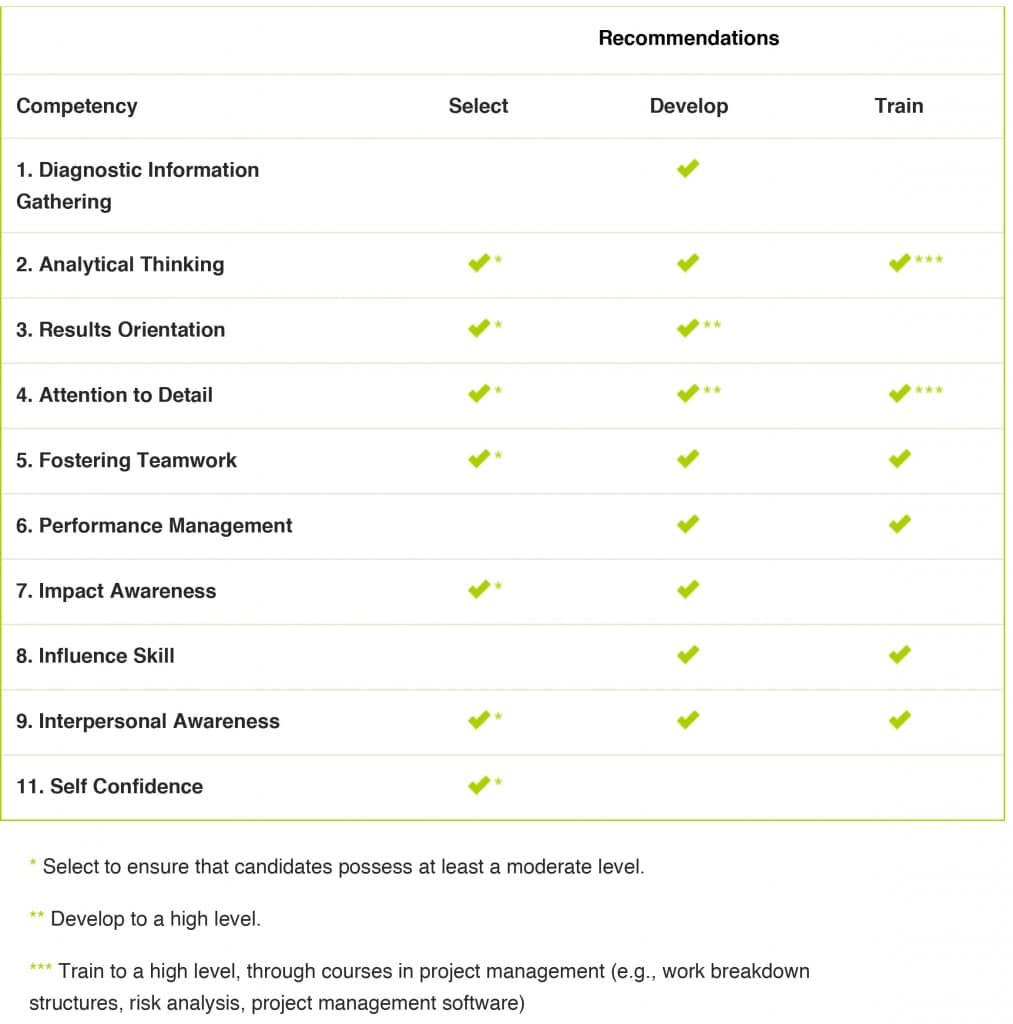
The table below is an extract from an actual competency model completed for a Project Manager position. It summarizes recommendations regarding selecting for or developing the competencies in the position.
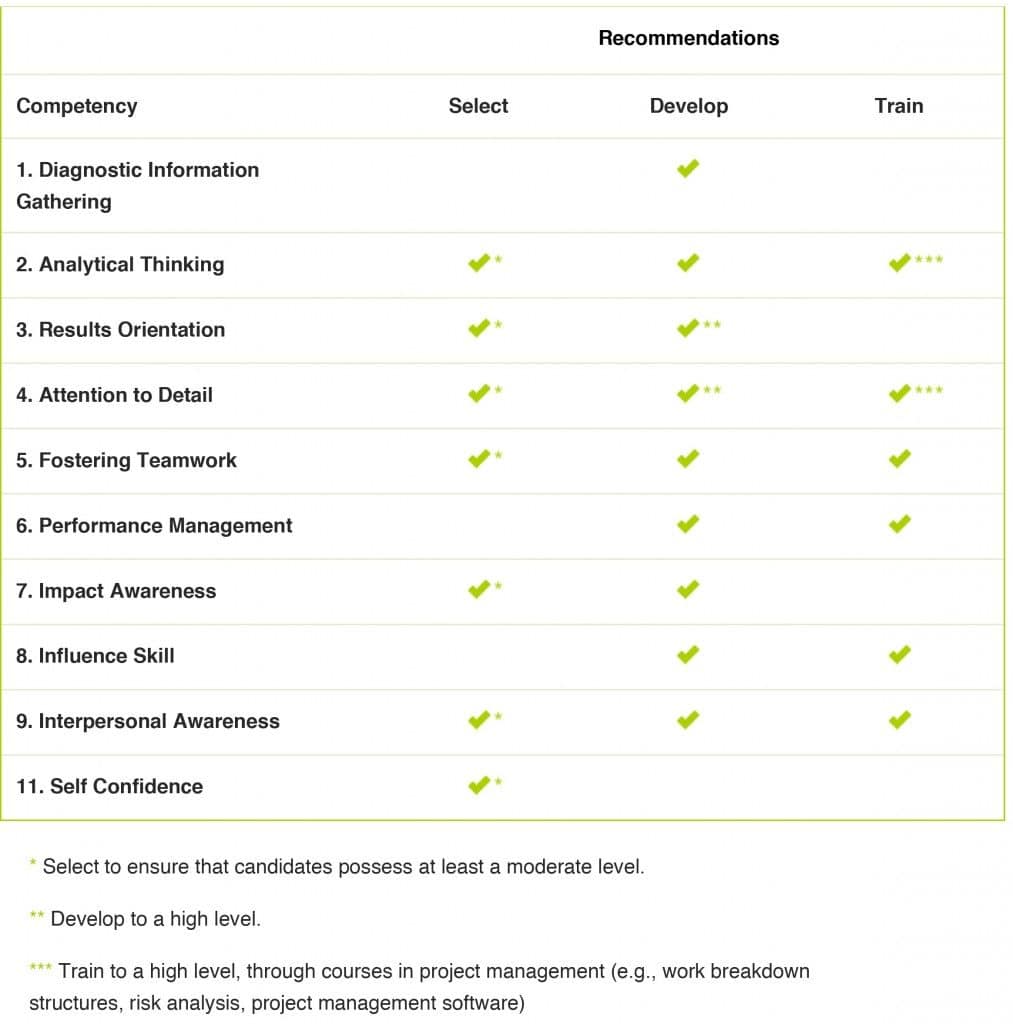 You’ll notice that seven of the competencies are recommended as selection criteria, due to the fact that they are deemed difficult to acquire on the job. These form the basis of your selection process and should be the primary skills assessed by your interviewers in their decision-making.
The competencies under the Train column are less critical than the others in the recruiting process, as they can be acquired through experience and on-the-job training. The competencies under the ‘Develop’ column refer to skills that can be further developed with proper coaching or mentoring, granted that the interviewing candidate demonstrates learning abilities and motives to do so.
Ideally, all the competencies in the model should be criteria of selection. However, what this exercise shows is the value of rating competencies once your model has been developed. Doing so provides a means of determining the relative importance of each competency in the decision to hire or promote.
For example, given two candidates who each possess 9 of the competencies, the candidate who lacks Self-Confidence (a competency recommended for selection) is much less desirable than the one who lacks Managing Performance (a competency recommended for training). The operating principle behind these guidelines is to select or promote into the target jobs according to the competencies that are most difficult to develop, and not to give excessive weight to the other, more developable competencies.
Developing your employees’ competencies
Understanding that your selection process should account for candidates who not only possess the right skills but also show great potential in developing additional competencies is one thing, but the process doesn’t stop there.
To ensure that you and your employees derive value from a competency-based assessment, it is important to ensure that further to the selection of qualified applicants:
- You implement and utilize the right development and performance evaluation programs
- Your employees make use of these assessments to plan their own growth
Your competency-based system therefore needs to define a process by which development and other related activities will occur. The process should describe a sequence of activities and expectations of the participant, the participant’s manager, HR, and the participant’s coach, if any.
Two tools are needed for this purpose: a development planning form and a resource guide with ideas for developing each competency.
The development planning form usually includes the following features:
- A requirement to target a small number (2-4) of competencies for development
- Specific activities to develop or practice each targeted area
- Dates set for the accomplishment of the activities
- Criteria or processes by which the participant will assess his/her mastery of the targeted areas
The resource guide is a book that provides general guidance on ways to develop competencies, including:
- Books, articles and other readings explaining a competency and describing ways to use it effectively
- Internal courses offered by the organization
- External courses endorsed by the organization
- Ways to practice the competency or apply it on the job
- Ways to learn from experts (by observing or interviewing them)
- Coaching suggestions for managers
Workitect’s Competency Development Guide and eDeveloper™, The Successful Manager’s Handbook and The Successful Executive’s Handbook are great support tools in this area. However, if your competency models use competencies that differ significantly from the generic competencies presented in these manuals, you may want to develop a customized resource guide, so that your employees can easily find ideas for developing each competency.
Remember that consultants who specialize in competency-based assessment and development can also create a customized resource guide for you. Furthermore, if your program involves coaching, you may want to consider bringing in professionals to work with your employees (typically six months to a year) to help with their development plan and improve their skills on the targeted competencies. Professional coaches can add tremendous value in motivating your employees to reflect on their behavior and think through challenges they are experiencing in their jobs and their careers. Here again, remember that coaching should be tailored to the needs of each participant, and The Executive Coaching Forum website offers many excellent free resources on this topic.
The value of a competency-based approach to talent management and workforce planning isn’t just in what it can do for your recruiting process, but how it can be integrated to every one of your HR processes: selection, assessment, performance management, training and development, succession planning, etc.
Read more about the different applications of competency models, or contact a Workitect consultant to discuss your particular situation.
 To learn more about our products and services, and how competencies and competency models can help your organization, call 800-870-9490, email edward.cripe@workitect.com
or use the contact form at Workitect.
©️2019, Workitect, Inc.

Related Posts
Recent Posts

In Good Times & Tough Times, You Need Competent People
People. Not money, not buildings, not tools. Competent people are your most valuable resource. And…

What is the One-Size-Fits-All Competency Model?
In the One-Size-Fits-All Approach, a competency model is developed for a broadly defined set of…
Is Your Performance Management System Working?
If it isn’t working, consider a… COMPETENCY-BASED PERFORMANCE MANAGEMENT SYSTEM Many organizations are becoming…

The New Reality: Career Streams vs. Career Ladders
Along with many other changes in how employee performance is managed, there is a…