
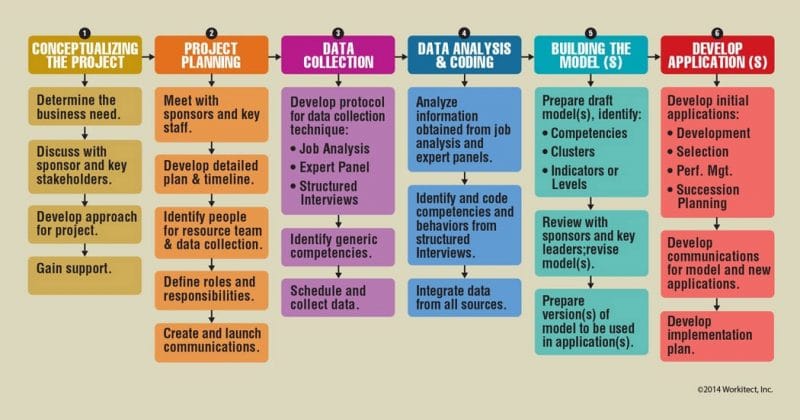
Build Models With Input From Job-Holders
SECONDARY DATA COLLECTION METHODS
Observation of Job Holders
Observation of job holders can be helpful in developing competency models, if a limited duration of observation will permit observing highly effective behaviors. For most professional and managerial jobs this is not the case. Job holders demonstrate their most effective behaviors infrequently, and the presence of an observer may affect the behavior of the job holder and others being observed concurrently. In addition, much significant behavior may involve thought processes that are not directly observable.
But if effective behaviors occur frequently and can be seen or heard, observation may be a useful tool to include when building a competency model. For example, it may be possible to listen in on customer service representatives as they respond to calls from customers. Observation may also be useful when studying jobs that involve physical skill or dexterity.
When using observation, plan to observe several superior performing job holders for a set period of time (e.g., 2 hours each). Take notes on what you see and hear. If possible, set aside 15 minutes to discuss your observations with the person you observed. You can compare your observations with a set of generic competencies and behavioral indicators, like the Checklist for Noting Themes in Structured Interviews that appears in the Building Competency Models workshop workbook.
Surveys of Job Holders
A survey of job holders can be useful if you wish to validate a set of job tasks identified in Job Analysis Interviews or in a Resource Panel. On the survey, job holders can be asked to rate how often they demonstrate each task, as in the following rating scale.
|
1 |
2 |
3 |
4 |
|
Rarely or Never |
Occasionally: |
Often |
Very Often |
|
Less than once per month |
Once a month to once a week |
Two to five times a week |
Six or more times a week |
Job holders can also be asked to rate how important each task is to effective job performance, as in the following rating scale:
|
1 |
2 |
3 |
4 |
|
Unimportant |
Of Some Importance |
Important |
Very Important |
By tabulating the ratings, you can calculate average frequency and importance ratings for each task.
It is not as useful to have job holders rate competencies and behavioral indicators. If, as is typically the case, the competencies have been defined to reflect superior performance, in an average sample of job holders, only a minority will actually demonstrate any competency or behavioral indicator. Yet because of the general human tendency to evaluate oneself highly, most job holders will rate themselves highly on most behaviors.
 To learn more about our products and services, and how competencies and competency models can help your organization, call 800-870-9490, email info@workitect.com
or use the contact form at Workitect.
©️2019, Workitect, Inc.

Related Posts
Recent Posts

In Good Times & Tough Times, You Need Competent People
People. Not money, not buildings, not tools. Competent people are your most valuable resource. And…

What is the One-Size-Fits-All Competency Model?
In the One-Size-Fits-All Approach, a competency model is developed for a broadly defined set of…
Is Your Performance Management System Working?
If it isn’t working, consider a… COMPETENCY-BASED PERFORMANCE MANAGEMENT SYSTEM Many organizations are becoming…

The New Reality: Career Streams vs. Career Ladders
Along with many other changes in how employee performance is managed, there is a…