
Using Resource / Expert Panels to Build Competency Models
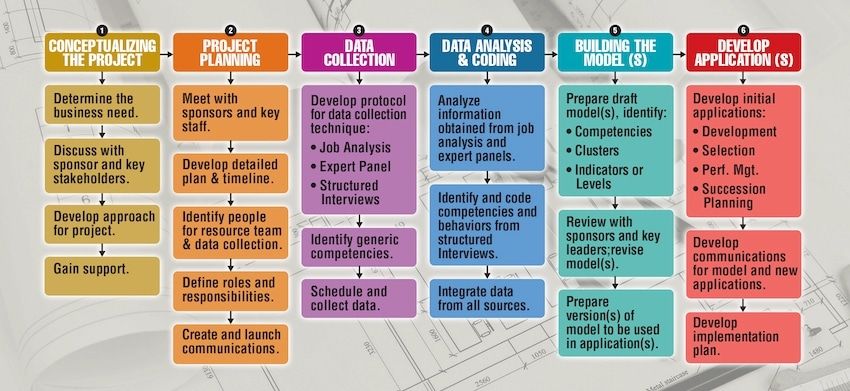 A Component of Step 3 of Workitect’s Model-Building Process.
A Resource Panel is a three to six-hour facilitated meeting with an agenda that is similar to, but broader than, the one covered in a Job Analysis Interview. The participants usually include 3-4 capable job incumbents, 3-4 managers of job incumbents, and 1-2 HR staff who work closely with job incumbents. A Resource Panel has three main purposes: (1) to gather data needed to identify the competencies for the job, (2) to build consensus among a set of key stakeholders about what the job requires, and (3) to build support for the project.
Typical Agenda for Resource Panel
A typical agenda for a Resource Panel includes the following components:
- Explain and sell the project.
- Identify and reach consensus on four or five main responsibilities for the job.
- For each responsibility, identify:
- Key tasks
- Performance measures or criteria
- Skills and personal characteristics needed
- Future scan:
- – Identify ongoing or anticipated changes in the organization, industry, and relevant technology that may affect the job.
- – Identify what each change implies, in terms of additional skills and personal characteristics that job incumbents will need.
- Individually review a set of generic competencies and select a subset of these that are most important in the job.
- Review individual rankings of competencies and reach consensus on a set that panel members consider to be most important for the job.
Advantages and Disadvantages of Resource Panels
Resource Panels have many advantages. They involve stakeholders early in the process and build support for the competency model and its planned applications. Conducting a resource panel is an inexpensive way to build a solid basis for a competency model. But Resource Panels also have some disadvantages. It can be difficult to obtain participation from job incumbents and their managers, especially if people are geographically dispersed. The standard agenda involves an analytical process that is too detailed and time-consuming for many senior managers. Resource Panels are a good method for identifying required competencies, but they usually provide little help in identifying behavioral indicators for the competencies judged to be important.
Considerations in Implementing Resource Panels
Since a Resource Panel may be seen as an important event within an organizational unit, there is a possibility that leaders and other key staff may feel snubbed, if they are not invited. Since the Resource Panel may make decisions that all staff will need to live with, the composition of the panel must have credibility, and key sub-groups within the organizational unit should be represented on the panel.
 Facilitating Resource Panels
-
- Among the challenges for facilitators are:
- Capturing detailed responses quickly and legibly on flip chart pages and posting the completed pages around the room
- Ensuring a clear conceptualization of the main responsibilities
- Keeping the process moving
- Intervening appropriately if the group bogs down or goes off on a tangent
- Maintaining control of the process
If possible, use two facilitators: one to facilitate and the other to capture responses on flip chart pages. The two can switch roles for different parts of the agenda.
Analyzing Resource Panel Data
Usually, only one Resource Panel is conducted to gather data about a job. After the panel session, the facilitator should transcribe the notes so that each question is listed, followed by the group’s responses. The result is a document that can easily be reviewed by the project team. Another useful addition to a Resource Panel is an administrative person to transcribe the flip chart pages onto a laptop computer, as the pages are being generated.
Variations on the Resource Panel Agenda
- Tailor agenda to the needs of the project and to constraints in the availability of panel members.
- Devote a portion of the Resource Panel’s time to a planned application.
- If the competency model needs to include technical competencies, members of the project team should spend some time with subject matter experts prior to the Resource Panel.
- Use a virtual resource panel to allow panel members to provide the information individually and at their own convenience and in their own work location.
- Focus on a set of jobs within one organizational unit and identify required levels for both technical and non-technical competencies.
Additional Information
Use an Expert Panel to Build a Basic Competency Model
Quick-Start Competency-Modeling Program (included with Competency Dictionary)
Building Competency Models workshop.
 For additional information, call 800-870-9490, email edward.cripe@workitect.com
or use the contact form at Workitect.
©2019, Workitect, Inc.

Tags: building, competence, competencies, competency, data, human, job, modeling, models, panels, talent
Related Posts
Recent Posts

In Good Times & Tough Times, You Need Competent People
People. Not money, not buildings, not tools. Competent people are your most valuable resource. And…

What is the One-Size-Fits-All Competency Model?
In the One-Size-Fits-All Approach, a competency model is developed for a broadly defined set of…
Is Your Performance Management System Working?
If it isn’t working, consider a… COMPETENCY-BASED PERFORMANCE MANAGEMENT SYSTEM Many organizations are becoming…

The New Reality: Career Streams vs. Career Ladders
Along with many other changes in how employee performance is managed, there is a…