Collecting Data to Build Competency Models
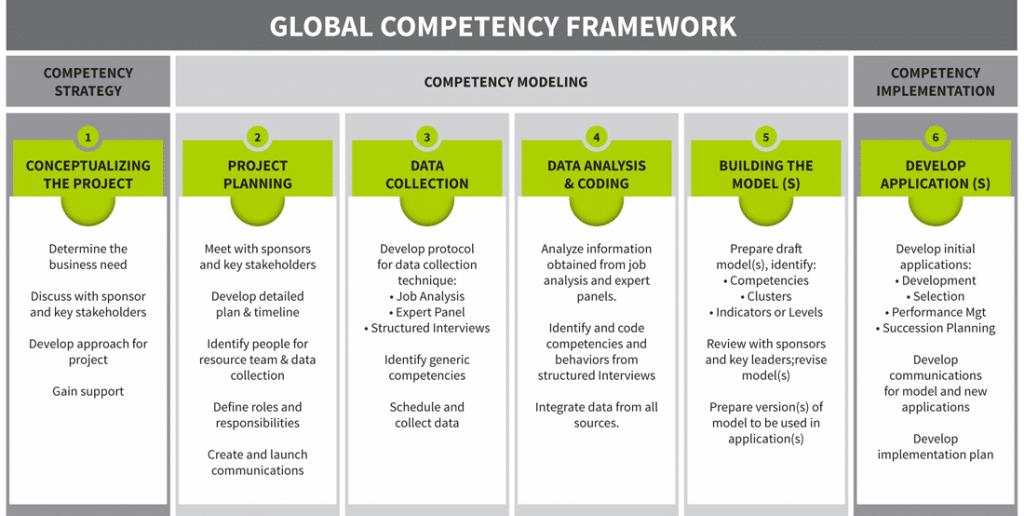
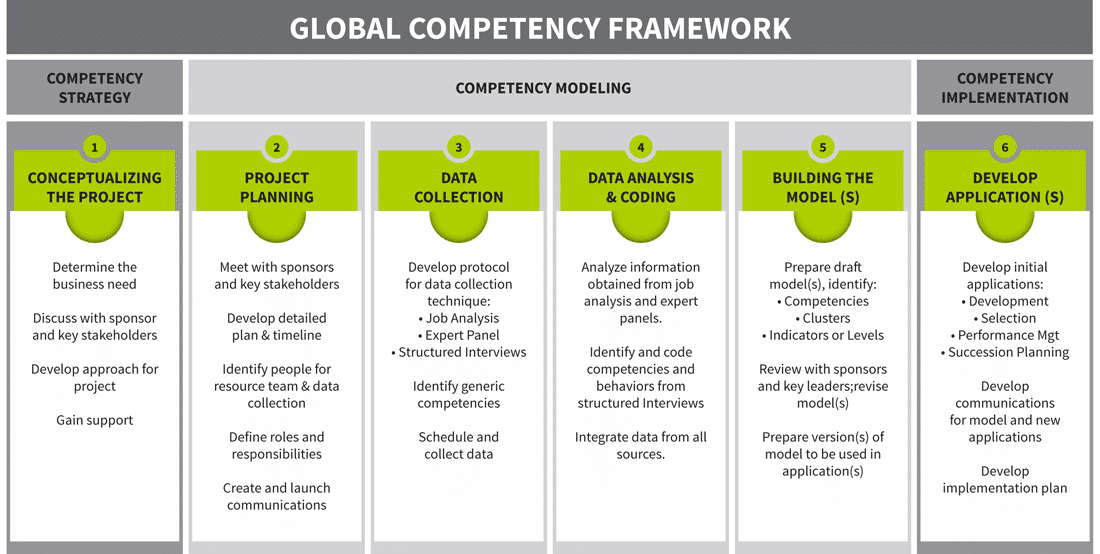
The project plan that is completed in Step 2 (Project Planning) will have included one or more methods of data collection that are appropriate for the project. This blog presents different data collection methods used in building competency models, along with suggestions for implementing each method.
Step 3. Data Collection
Includes several general tasks common to most data collection methods.
- Developing key communication points about the project, to be shared with persons from whom data will be collected
- Identifying a set of generic competencies from which competencies will be selected or adapted
- For each data collection method, developing a protocol with standard questions and procedures for recording responses
- Training or preparing data collection staff
- Selecting participants for each data collection method
- Communicating with participants to invite their participation
- Scheduling data collection activities
- Implementing the data collection method (e.g., holding interviews, resource panel)
General Data Collection Tasks
1. Developing Key Communication Points
In order to get the support of people from whom you are gathering data, you need to be able to explain what you are doing and why. For this purpose it is useful to outline some communication points that you can use in emails, presentations, and conversations with the participants and other project stakeholders. The communication points should include:
- A description of what you are developing (the competency model and the initial application of the model
- The name(s) of the project sponsor(s)
- How the competency model and application will be used in the organization
- How this will benefit the organization
- Main project steps and timeline
- How people were selected to participate
- What the participation involves for each data collection method
- Assurances of anonymity and/or confidentiality where applicable
You can draw on these communication points to develop specific communications as needed.
2. Identifying a Set of Generic Competencies
Because so much competency modeling has been done over the past 30 years, it is not necessary to develop a new competency model from scratch. Consultants and researchers who have done extensive competency modeling work have prepared dictionaries of generic, or frequently occurring non-technical competencies. Each competency in the dictionary usually contains a definition and a set of conceptually related behavioral indictors. For example, the staff of Workitect has developed several developmental resource guides that include generic competencies. Selecting or adapting a set of generic competencies streamlines the process of competency modeling.
To identify a set of generic competencies for a particular project, the project leader selects relevant competencies from a generic competency dictionary and reviews these with the project sponsor and other appropriate staff. The goal is to identify a set of competencies that will encompass all personal characteristics and skills relevant to the jobs under consideration and all other jobs for which will competency models may be built. Sometimes it is desirable to adapt the names of the competencies and the language used in the definitions and behavioral indicators to reflect language and concepts used in the organization.
If it is important to identify technical competencies, you can consult one or more subject matter experts within the organization to help identify and draft a set of technical competencies for use in the competency modeling project. The technical competencies should also be reviewed and revised with the project sponsor and other appropriate staff.
Identifying a set of generic competencies is especially important when the Multiple Jobs Approach is being used. The generic competencies are common building blocks used to construct each competency model. These generic competencies ensure use of a consistent conceptual framework across jobs.
The generic competencies are also useful when using the Single Job Approach and the One Size Fits All Approach. For example, if a resource panel is used as one of the data gathering methods, the panel members may be asked to rate the importance of each of the generic competencies to the job under consideration.
3. Developing a Protocol for Each Data Collection Method
A protocol is a document developed to guide the data collection process. It always includes questions for participants. It may also include instructions for the interviewer or facilitator about points to explain and procedures to use to collect and record data. The purposes of the protocol are to (a) ensure consistent communication about the project, (b) maximize the chances of full, honest participation from participants, (c) ensure that all planned questions are asked (d) ensure consistency when the data gathering method will be used with more than one person or group, and (e) ensure consistency of capturing or recording data by the interviewers or facilitators. Interview guides, resource panel outlines, and survey forms are all examples of data gathering protocols.
4. Training or Preparing Data Collection Staff
If two or more persons will be conducting interviews or facilitating resource panels, it is important that these persons use a consistent process. Most of the methods we will discuss do not require special training for staff who have had experience interviewing and facilitating groups. But it is important to hold a meeting of the interviewers or facilitators and to walk through the planned process and ensure that everyone is clear about the procedures for asking questions and for capturing participants’ responses.
5. Selecting Participants for Each Data Collection Method
The first thing to consider in selecting participants is who will provide the most useful data. Also important is the breadth and credibility of the participant sample taken as a whole. If the job has incumbents in several regions or business units, you should try to select participants from all of these regions or business units. In addition, ensuring diversity among the incumbents selected is important.
6. Communicating with Participants to Invite Their Participation
Before communicating directly with participants, it is important to communicate first with their management. You may need to prepare a draft communication for the project sponsor to send out for this purpose.
Use the communication points described under Task 1 to prepare appropriate communications for the participants. Most likely, you will use an email for this purpose, but you may also need to prepare and deliver one or more brief presentations about the project.
7. Scheduling Data Collection Activities
This is a necessary step that requires little explanation. If you are conducting interviews, you should allow at least 15 minutes between interviews and, if possible, hold them all in a room booked for that purpose.
8. Implementing the Data Collection Method
This process is taught in Workitect’s Building Competency Models workshop.
Specific implementation procedures will be discussed in subsequent blogs on each data collection method.
Q – Which step is the most difficult one to carry out?
 To learn more about our products and services, and how competencies and competency models can help your organization, call 800-870-9490, email info@workitect.com
or use the contact form at Workitect.
©️2019, Workitect, Inc.
Tags: building, competence, competencies, Development, factors, framework, HR, job, management, modeling, models, success, system, talent
Related Posts

Recent Posts

In Good Times & Tough Times, You Need Competent People
People. Not money, not buildings, not tools. Competent people are your most valuable resource. And…

What is the One-Size-Fits-All Competency Model?
In the One-Size-Fits-All Approach, a competency model is developed for a broadly defined set of…
Is Your Performance Management System Working?
If it isn’t working, consider a… COMPETENCY-BASED PERFORMANCE MANAGEMENT SYSTEM Many organizations are becoming…

The New Reality: Career Streams vs. Career Ladders
Along with many other changes in how employee performance is managed, there is a…